
Song of the Day: Everlasting Light — The Black Keys
“Let me be your everlasting light / The sun when there is none / I’m a shepherd for you, and I’ll guide you through / Let me be your everlasting light….Oh baby, can’t you see? / I’m shining just for you / Loneliness is over / Dark days are through, they’re through”
To be honest, I hadn’t really thought about the religious flavor of the lyrics until typing them out just now, but they do seem fitting for a pilgrimage. And at some level seem fitting for what I was ruminating on today: the idea of blessings / happenstance / gifts from the universe / however you want to call them
After my dinner last night of campground duck confit and crème brûlée (things that simply could never go together in the U.S.), I cut through the pilgrim tent-pitching area to get back to my caravan. That is where I ran into Karel, a pilgrim from Belgium who was making his way to Compostela, but was struggling due to lack of information (as he described to me). He was following a route on Open City Maps, but didn’t have great information about places where he could stay every night. I know there is a spider’s web of routes to Compostela across all of Europe, but I was interested that he seemed to have trouble finding resources for a route from Brussels. I explained that I didn’t have much to offer, but suggested he might search online for an accommodation list similar to that provided by the Confraternity of Pilgrims to Rome.
Karel was happy to chat about this and previous pilgrimages he had made before, including another pilgrimage to Compostela 20 years ago. Though he didn’t make this connection explicitly, his stories for the most part revolved around the concept that “the Camino provides,” a saying I have heard many times regarding the Camino de Santiago. Essentially, it represents the idea that the universe, and the strangers you meet, will take care of you on your pilgrimage when you need it most. For Karel, that meant serendipity, like walking up to a bus stop feeling like you can’t walk any further, and immediately having a bus pull up headed to where you need to go; arriving in a town to find the only hotel is closed for the holidays, but the gardener and his wife offer to take you in; meeting a man fifty years younger than you who offers to drive you the 5km to the next town. This last one I found most interesting: as he described it, he remembers telling himself “don’t be stupid, Karel — take the ride. You’re tired.” As a woman hearing that, I could only smile to myself. My inner voice would have been telling me “don’t be stupid, Eva — no matter how tired you are, don’t get into a car with a man you don’t know.”
Even before this conversation with Karel I had been thinking about the idea of the Camino providing and how, 10 days in, I didn’t necessarily feel I had witnessed that sort of good luck, or whatever you want to call it. Not that I’ve had bad luck or a bad time, but I didn’t feel I’d had any of those sort of magic moments that stood out to me yet.
I was still thinking about the idea this morning as I woke up, snoozed my alarm (twice!), struggling to convince myself to leave the comfort of the campervan. Finally I managed to rouse myself at about 7:15 and begin my morning routine of packing for the day, going to brush my teeth, filling up my camelback, etc. I sat on the patio area by the campervan and had a granola bar as my breakfast, and finally by about 8:15 was bidding the campground farewell and on my way, about 12 miles ahead of me till Tergnier. I had really enjoyed my campground experience — everything was very convenient, the location was nice, I liked the campervan, and I liked walking around and seeing everyone else’s set-ups. It was one of the first places I left where I realized that I would likely never return (though this is true for many places I have passed through already), so I bid it a fond farewell.
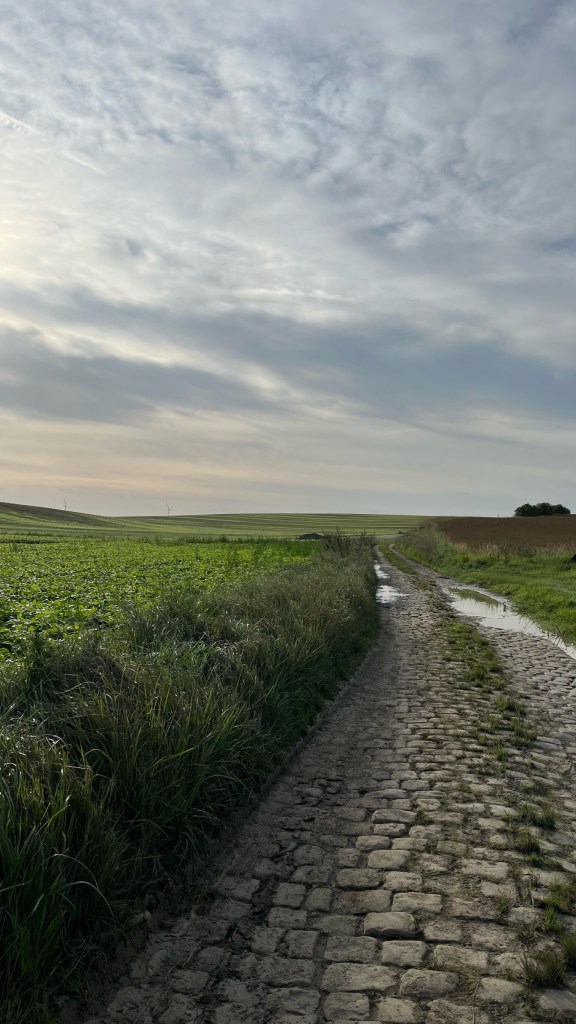
After a brief uphill on my way out of Seraucourt, I was back in flat, flat, farmland on backroads paved with stones (almost like a Roman road) instead of asphalt. Yet another reminder of Rome — I really miss it, and I miss my life there. It’s only been 2 weeks or so since I left, but it feels like such a long time ago.
I don’t have much new to say about the scenery at this point — you probably know it as well as I do. On my way into Peronne, I had described it to my dad as “the Kansas of France.” I still think this feels accurate (though admittedly, I’ve never actually been to Kansas). More flat, expansive fields of grain (and beets, apparently that is the leafy plant I have seen everywhere). The windmills, a constant companion since Arras, are still there, but fewer and further away on the horizon.
The first village I passed through was Clastres, which does not have a single commercial enterprise in town — not dissimilar to the many other villages I have passed through these past few days. I haven’t seen a single open cafe, restaurant, or bar since Peronne. And the only open cafe in between major towns was all the way back in Tournehem. It somehow makes the solo walking seem even lonelier, to have nowhere at all to sit and get something to eat, and no one to talk to (even if I struggle to communicate in French). Clastres did have a lovely, closed, church. Outside of town though, I heard the sound of engines revving on the horizon. I was confused — motorcycles? ATVs? but it didn’t quite sound right, and the sounds weren’t getting any closer or further away. It couldn’t be someone on the road. Then, finally, I realized why I knew the sound — there was a karting track a few fields away. I couldn’t see it, but I could hear it.
After Clastres it was 30 minutes or so to Montescourt-Lizerolles, a somewhat strange suburb centered along one long, Main Street lined with trees and blue light posts. I saw online that Montescourt had a boulangerie that was only a few blocks off of my route. My intention, initially, had been to get a second breakfast and take my break there. But as I walked into town and saw the other shops and restaurants, all closed on a holiday, I started to lose faith. At the turn-off, I started to head up the path and away from the route to the bakery. I’m not sure why, but after walking only a few steps I decided that no, even though every other boulangerie I have passed for days has been closed, even though I knew it was a holiday, I would give this one a shot. Yes, I was already tired and my feet were hurting, but if it was closed it would only be a few minutes out of my way. Still, I had no hope as I continued along the main road. Until, someone passed me holding a brown paper bag. No, it couldn’t be… A woman a block ahead of me got into her car, holding what looked like a baguette. Is it possible?
Ever superstitious, I refused to believe it until I was in front of the boulangerie, which was in fact open and doing a brisk business. A family slid in front of me in line as I was about to go to open the door. And it’s a good thing they did, and it’s a good thing I slept in, and it’s a good thing that I paused for a few moments to decide where to go, because just as I stepped up to order, a fresh tray of croissants, straight from the oven, was brought out from the back and deposited in front of me. I added one to my order of a croissant covered in chocolate (since they had no pain au chocolat), and made my way to a bench outside. Ever since I was a kid I’ve always debated the order in which I eat things: do I start with my favorite, or leave it for last? I’m sure there is a broader philosophical point to be made about this debate regarding prioritization and delayed gratification. This time, thought, there was no thought. I immediately went for the warm, fresh croissant. It was flaky yet pillowy at the same time. It tasted like butter and yeast. Every bite let out a warm puff of air. I texted my friend Theresa telling her about the experience: “this is the closest I’ve ever felt to god.”
I started in on my second croissant, which could not replicate the actual bliss of the first. I ended up saving most of it for later. Two men on their bikes came up to talk to me in the meantime, and were shocked to hear I was headed to Rome on foot (I didn’t have the French to explain that I would be taking the train to skip the Tergnier-Laon stage, but anyway, for the most part I am still going on foot). They wished me Bonne Courage and one of them, as he was getting on his bike, said to me (in French): “Your French is very good!” Ashamed, and unable to give my typical response that I give in Italian (“thank you, I’m still learning,”) I simply gave him a long “Non, non non, merci, ma non.” Still, even if I knew it was false, it was nice to hear. As I sat back and watched him pedal away, thinking again about the heaven that is a warm croissant, I felt that for me, today, the Camino had provided.
Leaving Montescourt, I was once again cutting through fields before finally joining up with the path alongside the St. Quentin canal. At first overgrown and barely a path — once again, my calves and ankles were bearing the brunt of the scratches — it eventually turned into a long, flat, asphalt track. At this point, I figured I was golden — I had about 1.5 hours of walking left, was over halfway there, and while my blisters were hurting they weren’t excruciatingly painful. The next bit should fly by.
Unfortunately, shortly after having that thought, I started to feel something moving around in my sock. The toe protection I had been using on my left pinky toe (the most painful and difficult to manage blister) had fallen off and was drifting around in my sock. This had happened before and I wasn’t worried — I continued walking, not thinking too much of it. Until, suddenly, I felt a sharp pain in the same toe. I couldn’t figure out what was wrong but it suddenly hurt. A lot. I plopped down right there on the asphalt and went to take off my boots – only to discover that my socks had fused to the tape I had been using to cover my blisters, and I couldn’t get them off. I managed to address the issue with my toe, but decided it was probably for the best — unfortunately — to switch to my sandals, which I hadn’t had to do in a few days. Everything from here was flat and should be paved, and I figured my feet would benefit from the air. Frustrated, I tied my boots to my pack — which, once again, made the pack just uncomfortably heavy, and began shuffling my way toward Tergnier.
I ended up making the decision to stay on the canal path (and therefore the official VF path) longer than Maps.Me suggested. This added about 10 minutes of walking, but it allowed me to avoid a D-road that appeared to have no shade at all. Finally, after passing 3 locks, no boats at all, one fisherman, and a few bikers, I crossed over the canal and then onto an extremely long pedestrian bridge over Tergnier’s rail depot. This thing was huge — certainly larger than Roma Termini — full of disused passenger trains, old cargo trains, and some full freight trains waiting to depart. It took almost 10 minutes to cross the full bridge.
I knew Tergnier had a major rail depot (in fact, it was such a central rail location that the Allies dropped over 16,000 bombs on it during WWII), and so I had (incorrectly) assumed that it would also be a somewhat major town. I was quickly disabused of that notion as I spent the last 20 minutes walking toward the center through what appeared to be a ghost town. Every shop was boarded up, no one was outside their houses — it seemed like each of the 13,000 residents had disappeared (they probably had, presumably to the coast or somewhere else on holiday). I finally made it to the church and realized that my plans to grab something to eat in town for lunch and dinner were probably unrealistic — it would be more pilgrim meals for me.
I called Pierre from the Diocese, where I would be staying tonight. Nathan had organized this for me, so all I knew was to call when I reached Rue Victor Hugo. I called and in broken French said something along the lines of “Hello. I am the pilgrim. I am here on Rue Victor Hugo. I am arrive. I am near the church.” Or at least, that’s what I thought I said, and I thought he said that he was coming to collect me. But 20 minutes went by and I realized I must have misspoken. I called back and asked if he spoke English — he did — and he came to collect me. Turns out I was just around the corner from the correct door.
This was my first donativo accommodation — a pilgrim accomodation that accepts donations rather than charge a fixed rate. I wasn’t sure what to expect, but I think at some level I figured it would be like the previous places, that the Diocese had some people living there and would offer additional rooms, like the Abbey. Not sure why I thought that as it’s not entirely logical in retrospect. Anyway, the accommodation ended up being very simple: a cot in a room above the Parish offices. No showers, but a toilet. Access to the kitchen. He handed me a key to the church, I thanked him profusely for the help, and he bade me farewell. I headed to the grocery store (passing another open bakery, and finally getting my pain au chocolat — yes that is 2.5 pastries in a day, no I do not feel ashamed), and returning with my ingredients for a salad it finally hit me that I would be alone in the church / parish complex for the night. My “bedroom” had no lock, the only door I had a key to was the front door of the church. Everything else, presumably, was locked. Trying not to be creeped out by the idea of being alone in such a large building overnight, I went to make lunch.
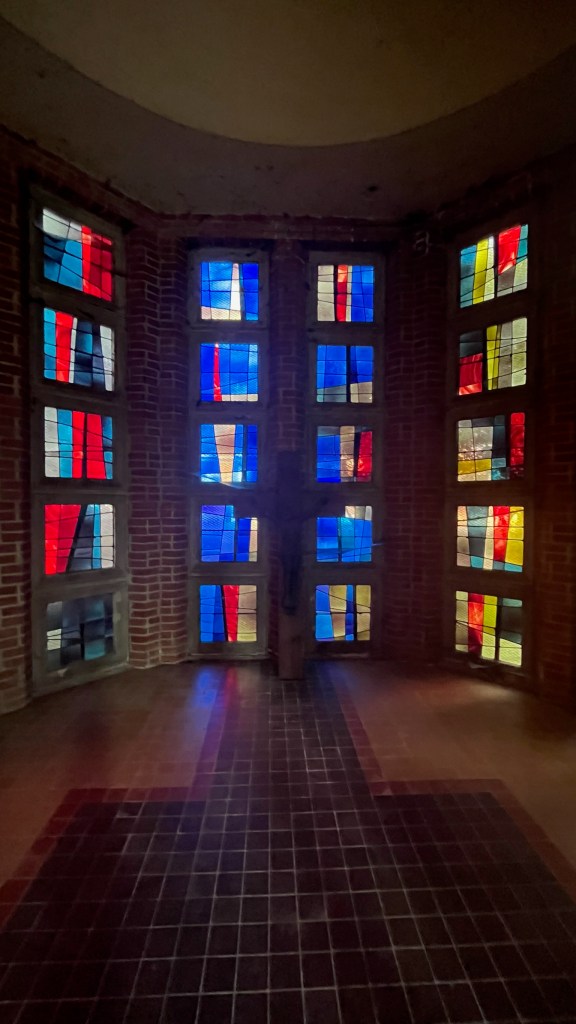
After lunch, I popped back into the main church building — the church has been rebuilt twice in the last century or so, as it was destroyed during both World Wars. The caretaker was in the church, playing the piano. I sat for awhile looking at the modern stained glass before heading back to the parish quarters. I’ve been sitting for over an hour now in the offices, writing. I will make myself dinner and head to bed — not much else to do! Despite my best efforts, I have a bit of the heebie-jeebies about being here alone. To be clear, I’m very grateful for the place to stay — just wishing I had a fellow pilgrim here with me.
Final mileage: 12.18 mi
Walking time: 4h 49m
Elevation gain: 92 ft
Accommodation: Le Diacre (The Diocese) in Tergnier. As described, the offering is a cot in a room above the parish offices, connected to the full church complex. It has access to a kitchen as well, but no showers. This was perfectly suitable for the night, and Pierre was very kind in fetching me and showing me around.


 Eva on the Via Francigena (and beyond)
Leave a comment