Song of the Day: Douce France — Charles Trenet
I’ve known this song since I was young (though I was partial to the other Charles Trenet song my dad used to play, ‘Boum!’). It’s a charming ode to a France that doesn’t really exist anymore, but it’s a song I’ve enjoyed singing along to at various times as I have literally walked across France. And today really felt like a day where I understood a bit better life in a small French village, through the people I’ve met and the truly warm hospitality I have experienced.
Today really was a day full of pilgrim spirit, though it didn’t necessarily start out that way. It’s been very interesting for me to see how this adventure has unfolded — I’ve tried to come in with limited expectations, so each of these interactions is new to me.
I woke up and had a lovely breakfast with Roger, who offered 2 fried eggs (delicious), bread, and a banana. Though the Slovenians had arranged for breakfast at 5:30, they evidently left without eating, so I felt bad that he had laid the table for 3 rather than just me. He continued to offer me more food but I was full, so had to politely decline. I showed him my planned route for today and he warned that some of the forest paths were overgrown, which made me a bit nervous — I quickly assessed and came up with a plan B on roads instead.
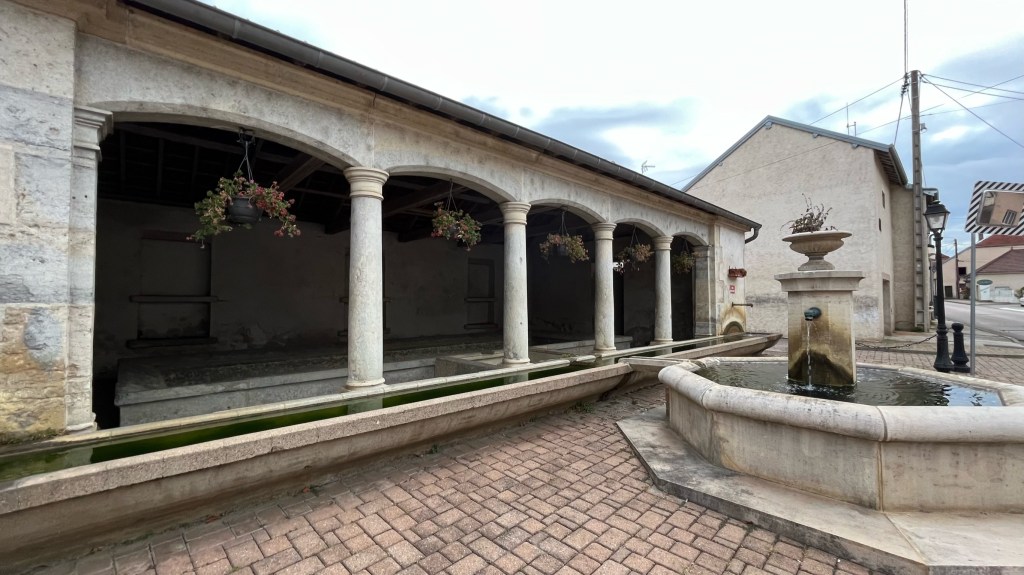
After a minor mishap — I forgot my hiking poles at the gite, and had to run back to grab them (luckily I didn’t get more than a block away) — I was out on the road out of Seveux. I hadn’t seen the village yesterday after my arrival, but found it to be quite charming with a very nice lavoir. On the way out of town I realized I was having trouble drinking from my freshly-cleaned camelback, and realized I hadn’t correctly attached the bite valve. I spent 5 minutes wrestling with it before declaring it a lost cause and continuing on.
I got another late start today, so the sun was up as I walked a small road through flat fields out of town. I had “The Long and Winding Road” stuck in my head (my dad had referenced it regarding a photo I had taken the night before) so I decided to listen to it as I walked. And I have to say, I don’t like disagreeing with Paul McCartney, but I actually do like the “overproduced” Phil Spector version. Really, I just very much like strings and any songs that have that cinematic, orchestral quality. They make very good walking songs and so does this one.
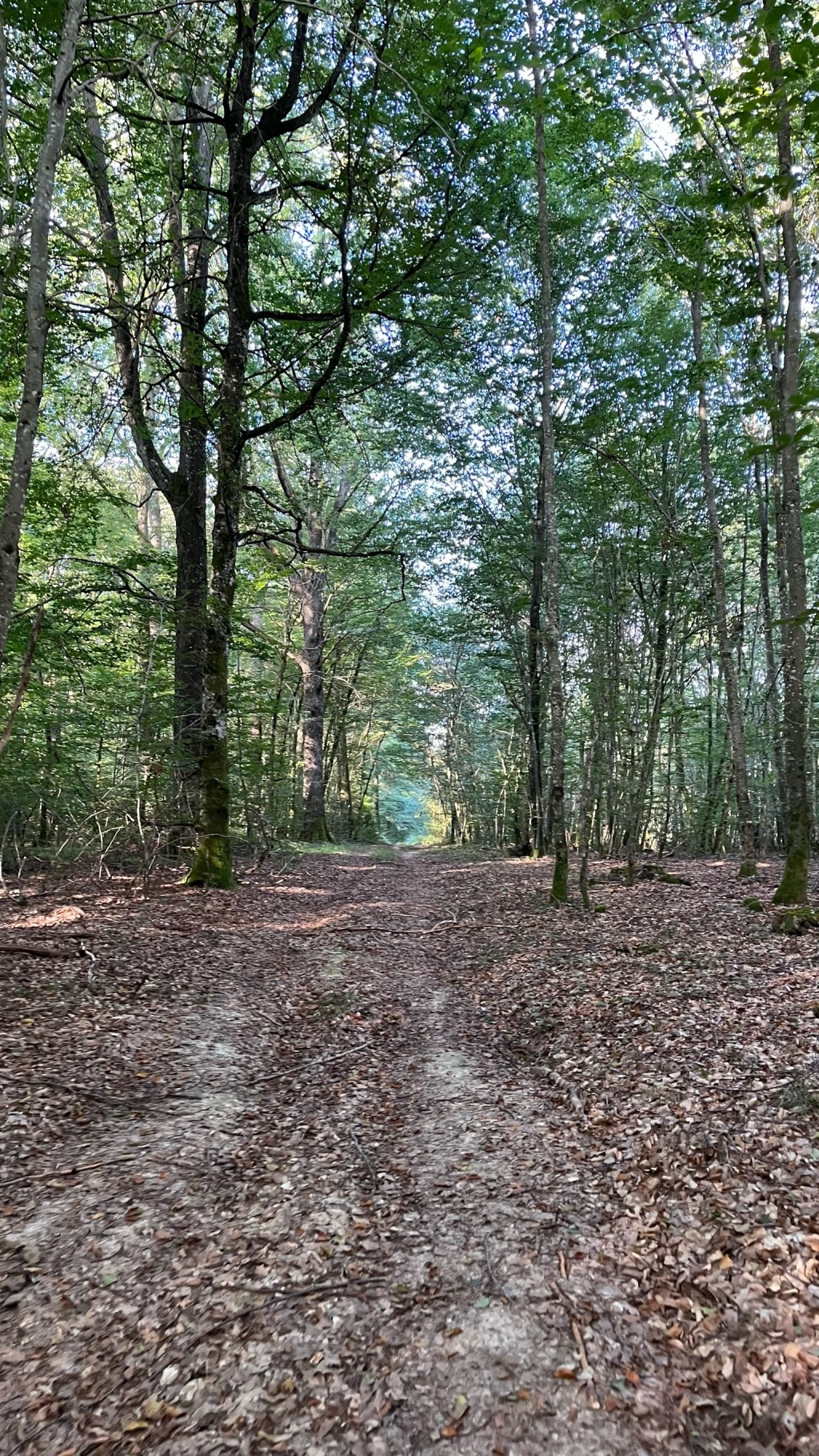
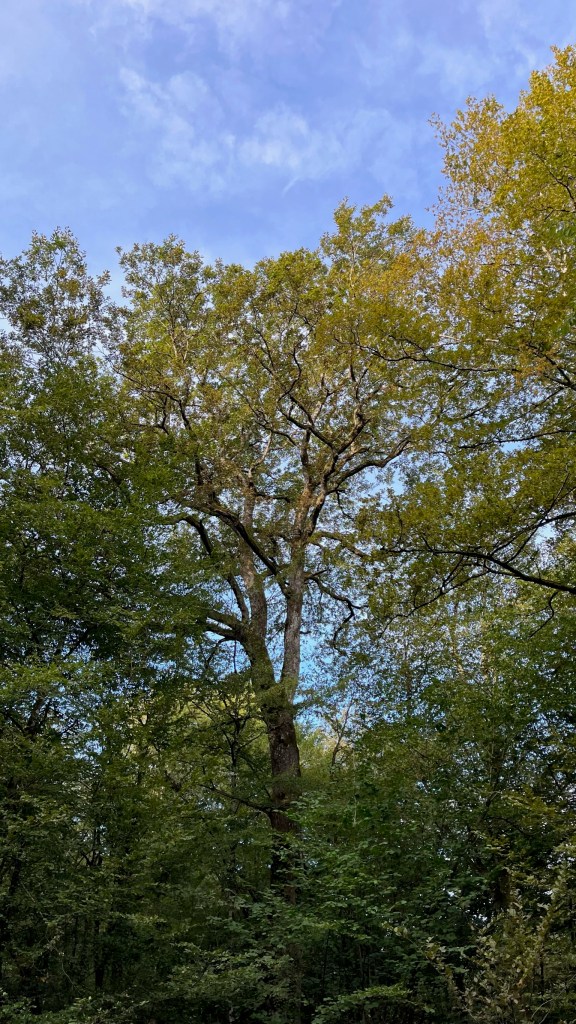
Soon I was firmly out of town, passing by grown-over abandoned farmhouses and empty pastures ringed by trees. Eventually I turned onto the road which cut through the forest. It was beautiful in the early morning light — quiet and tranquil. As I walked I passed by deciduous trees that reminded me of home, and then a section of tall pine trees. By the way, I looked it up, and apparently in 2021 they cut down some 200-300 year old oak trees which are set to be used for the Notre Dame roof repairs. This asphalted road ran out at what was allegedly a spring, and was clearly set up for some tourism, with multiple park benches and picnic tables. However the spring was barely flowing out of a drain pipe, and there was a large sign next to it: Eau Non Potable. Not very helpful for a thirsty pilgrim!
Here I continued onto a logging road, properly in the forest. I tried to enjoy this section but was very concerned about navigating — many of these paths weren’t marked or blazed in any way, and whenever they crossed other trails it was sometimes unclear which way to go. At a certain point the path was overgrown a bit and I had to fight my way through; at another, multiple paths originated in different directions except for the one I wanted. I ended up making it out of this section with minimal trouble, but as I looked across the road to the next forested section, I could tell that the path was obscured just a few meters up the way. I decided to take the road instead.
This was a quiet D-road that lent itself to some nice, contemplative walking. Eventually I happened upon a series of farms and stood for a while admiring the animals: cows, donkeys, goats, chickens, and….inexplicably…wallabies! I also decided to pause for a bit to rest my feet as I was worried about a hotspot on my left pinky toe — the former site of a blister, so I was dismayed to feel it hurting again. Around this time I realized that Maps.Me had rerouted me entirely — instead of passing through a series of villages on a small D-road, I would be cutting straight across on two other roads. In the end, I wish I had forced it to take me on the quieter route, as I didn’t enjoy the road walking today, but it all worked out okay.
The first stretch was in the sun, about 30 minutes along a road until La-Chapelle-Saint-Quillain, where I stopped for lunch on a picnic bench under a church. From here I was taking the D23, a straight shot to my destination. However, this road had a number of steep up and downs — fine from a walking perspective, but I don’t like these as they make it difficult to see oncoming cars. It also passed through the forest so would have large shady patches — I donned my hi-vis to ensure I was visible. This stretch was over an hour, unfortunately, and I was on high alert for most of it to ensure I could hear and see oncoming cars. For the last 30 minutes I tried to get myself through by attempting to sing Alice’s Restaurant — more difficult than it sounds, and my Arlo Guthrie impression leaves something to be desired.
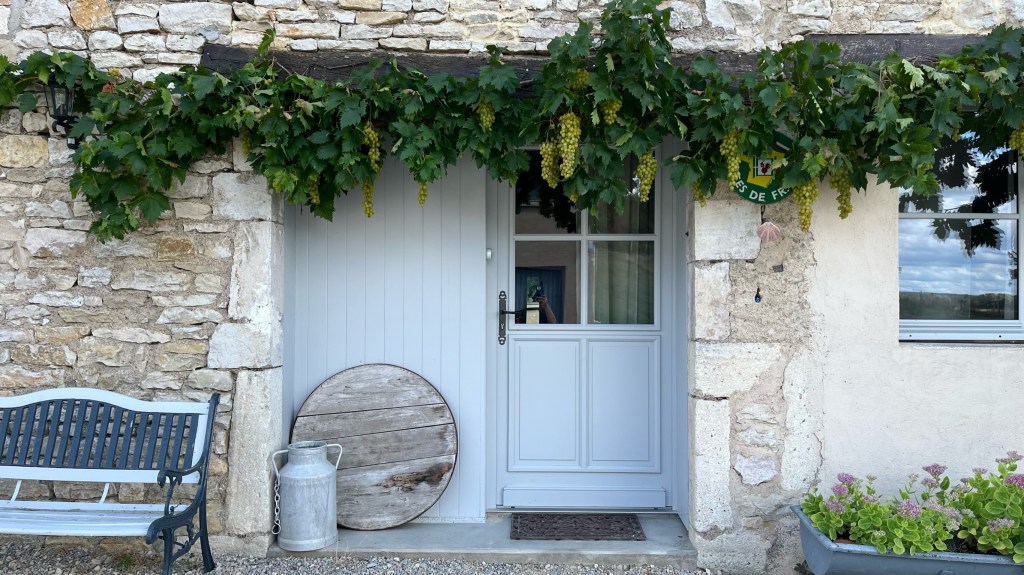
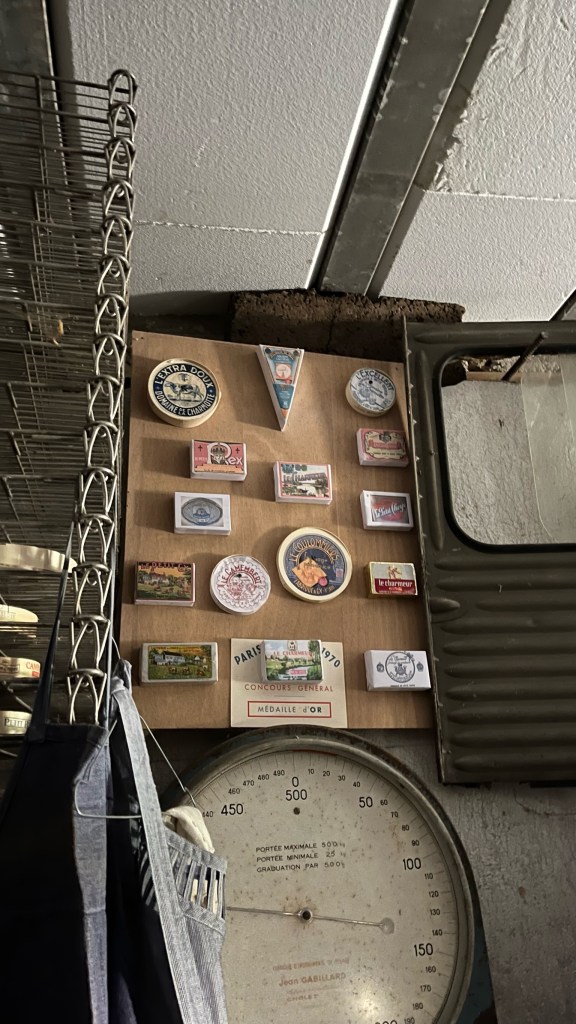
Finally, I arrived at the gite where I am staying tonight, where my host Claudine asked me to stop so she could take a photo as I arrived — not ideal that I was still wearing my hi-vis! She showed me to my room and after a quick shower, I joined her, her husband, and her mother for a delicious plum tart (made from garden plums, of course). Then Claudine showed me around the property, which used to be her family’s dairy farm. The gite itself was booked by 3 French couples, but she gave me a tour — it was beautifully renovated (within the last few years). She also showed me many of the artifacts she has from her grandparents and from the cheese business, which she maintains in a small museum in one of the former cheese caves. She also showed me around the grounds and introduced me to her animals — including a sheep that she says her and her husband take on walks with a lease, like a dog — quite a sight for the neighbors!
In the afternoon I decided to visit the village of Gy, which according to Google maps had an interesting chateau (Claudine warned me that the man who takes care of the property was an erratic character and may not let me visit, but I decided to give it a try). So, armed with a number of maps of Gy (“I used to work in tourism,” Claudine noted as she opened a cabinet stuffed full of tourist maps), I began the walk into town.
Gy is a well-preserved medieval village, and the tourist maps highlighted a number of key sights to see. However, I have to say — the maps were organized in a way that I completely could not understand. Main points of interest were numbered and labeled, but the numbering seemed completely random — if you realized you wanted to see, say, #14, looking at the map you would have a hard time finding it, as it might be completely opposite the map from #13 and #15. So I opted to use the map to tell me what I was looking at rather than trying to identify what I wanted to see in advance. I started up at the top of the town in the village’s church, which was quite a shock to enter. Certainly, we are out of the land of the Gothic — the church was open and airy, designed in the style of older basilicas with a large barrel vault for the nave and rows of Doric columns, rather than arches, delineating the aisle. The neoclassical architecture was interesting (a deliberate choice by a bishop seeking to reinvigorate the church) and tied into the architecture of the neoclassical Hotel de Ville (or perhaps vice versa).
From the church, I decided to try my luck at the chateau. I snapped a few pictures from the outside, where there was a sign saying the chateau was “ouvert” — however there was no open door to enter. I asked two women standing nearby, one of whom spoke English, and they encouraged me to ring one of the doorbells to speak to the proprietor. I must have rung the wrong doorbell because a young man stepped out, told me he would call the proprietor, and closed the door. Sure enough, a few minutes later an elderly French man in jeans and a wifebeater appeared, and asked me what I wanted. I said I wanted to visit the chateau, if possible, and he shook his head — minimum 5 people per tour, for 20 euros. I explained that I was alone and he nodded and walked away. Oh well, worth a shot.
On my way back from the chateau, I ran into the same two women again and said hello. We got to chatting in a mix of French and English (I will say, there has been a real inflection point in my French recently and I now am just barely able to hang on in a basic conversation). They both lived in Gy and were interested to hear more about my pilgrimage. After a few minutes of walking and talking together, one of them suggested we have a coffee together, which I happily agreed to.
As it turns out, these women were Claude, a Frenchwoman who lived in a village nearby, and Oksana, who along with her husband Dmytro had moved to Gy last fall from Kiev. Claude, Dmytro, Oksana, and I sat in the couple’s kitchen and had tea and snacks (homemade blackberry jam and local cheese) and discussed in three languages about the Via Francigena, about my life and work, and about life in Ukraine before the war. Dmytro worked as a historical cartographer — I asked if he worked for a university, and he explained that Ukraine had maintained a post-Soviet approach to the sciences. There are institutes for many subjects (“which, unlike in America,” he explained, “actually mean something”), and there is an institute for cartography who is his employer. He is continuing his work from Gy, and showed me the maps he is working on for an English translation of his book, which shows settlers in the Ukrainian territories since, essentially, the start of civilization. It was fascinating, and interesting to hear his commentary on key historical events like the Cossack revolution.
After tea, Oksana and I walked together back to the main town. She talked about how it was relatively easy for her to integrate, since she spoke French and had spent time in the country, but was more difficult for Dmytro and the other Ukrainian families in the village (there were 3 others). She said she hoped to return to Kiev, at some point, though of course it was impossible to know when that would be. When we reached my turn-off I thanked her profusely again for her hospitality (truly, I felt bad that I had nothing in return to offer her), and promised to keep in touch. As I walked back to the gite, stopping to pick up from bread for dinner, I reflected on the experience. Such a random, unexpected connection, and such warm hospitality.
Back at the gite, soon it was time for dinner, and I ate with Claudine and her family, as well as a friend she had invited over who was very knowledgeable about business and curious about my work. We had a delicious dinner of garden tomatoes, a tomato quiche, and beef and rice — paired with a 2010 Haut-Medoc Bordeaux. The conversation was interesting and wide ranging (I relayed my experience from town as Claudine actually knows Claude and Oksana). I was proud that I was able to get by (somewhat) in French, though I did sometimes shoot Claudine a nervous look and she would translate for me. By the end of the meal I was totally wiped out. Almost falling asleep in my chair, I headed to bed.
Final mileage: 12.87mi
Walking time: 5h 51m
Elevation gain: 335ft
Accommodation: Gite La Laiterie de la Charlotte. Claudine and her family were fantastic hosts, and while I stayed in a room in their house, the renovated gite was the nicest I have seen on my trip so far. And I was amazed to see how Clauding has preserved her family’s legacy.







 Eva on the Via Francigena (and beyond)
Leave a comment