
Song of the Day: Pulling Our Weight — The Radio Dept.
“In time we might walk the straight line / But with memories of a grapevine / A guitar, as we came close from far…”
I first was introduced to The Radio Dept. with their song “Heaven’s on Fire,” which I heard for the first time as maybe a 14 year old. I’d gotten it from some random indie playlist online and loved it. I’m not sure when I heard this song, but I’ve always enjoyed it and think it makes a great chill travel song that seemed to match the feeling of walking today in the cool grey fall weather.
Man, I am really tired. I’m not sure why. Sure, you might be thinking, “Eva, you’ve spent 48 days walking across Europe, including literally walking over the Alps, and haven’t had more than a day off since August.” That would make sense. But still — I’m not sure that it’s just cumulative exhaustion from the trip. Only a week or so ago I was waking up at 5:45 am for 6:45 am departures; today I had to snooze my alarm until 6:45. I think it is partly a delayed response from the Alpine section (and the long walk to Saint Vincent), but also now that I am on my own, the weather is (temporarily cooler) and the sunrise is later, I don’t have a strong motivation to leave early.
Anyway, it is what it is at the moment. Thankfully, today is a short enough day that I should have time for some light tourism (!). I had my scheduled 7am breakfast downstairs at the Casello — a warm cornetto that clearly was the same brand of frozen, bake-to-order cornetti we used to serve at the agriturismo. I recognized the smell immediately. Anyway, that plus a banana and a cappuccino (and an apple smuggled for the road) got me through packing and out the door around 8. The Casello is next to the train station on the edge of town, so I was out of Verres pretty quickly.
The first section of the day was a brilliant green: I walked through grassy fields, paralleling the Dora Baltea river, which is a somewhat alarming shade of greyish-greenish-bluish. It had stopped raining, but dark clouds clung ominously to the mountaintops, obscuring the views. I turned away from the river, crossing the rest of the valley into the village of Clos de Barmes, which sits at the base of a mountain. It’s not dissimilar to the other villages I have passed through: primarily stone construction, with timber accents and brilliant flowers. However, spotlit in the middle of town was its medieval wine press — a relic from a time when communal viticulture was a core part of the village economy. I stopped for awhile, studying it and trying to to understand how it works (I think I eventually figured it out). After quickly re-taping my feet (the new shoes were generating hotspots in my heels) I was back on the road.
I was heading into the town of Arnad, which sounded somewhat familiar…finally I realized that was because Patrick had sent me a message the night before saying a wild dog had come after him in this town. So, I was in no real rush to hang around as I walked through largely deserted streets. However, just as I was pondering this, I looked up to see an open Post Office, and headed inside. I had been planning to send off my old boots today and was hoping I would arrive in Pont Saint Martin in time — but no reason not to just do it now. So, 27 euro and just under 3 pounds lighter, I left the post office and made my way out of Arnad without incident.
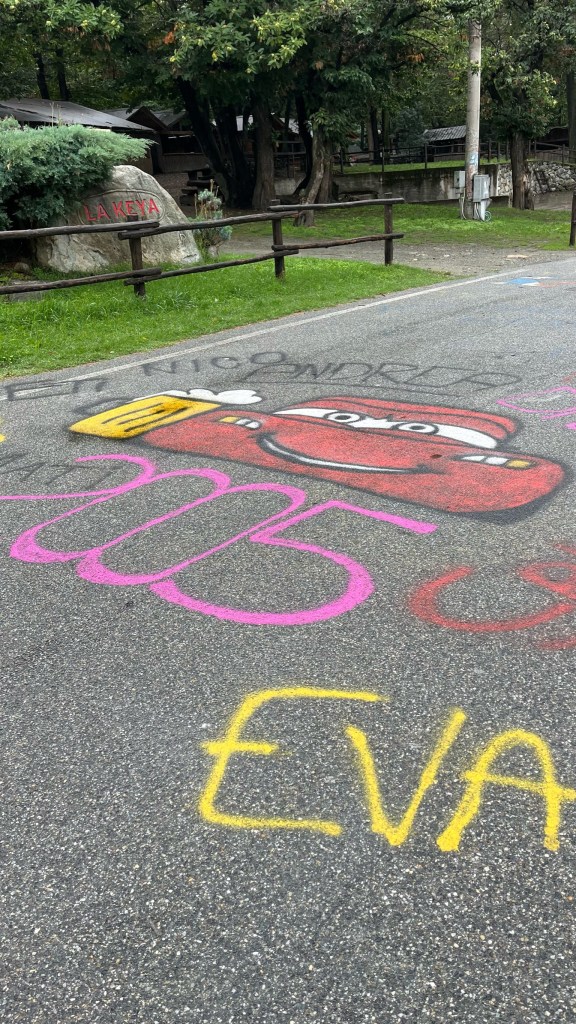
Here I passed through another town, where a local restaurant was offering an 8 euro pilgrim meal — though unfortunately they wouldn’t open for another few hours. On the road nearby were street paintings of cartoon characters: Homer Simpson, Lightning McQueen from “Cars”, and Donald Duck. Below them were years: 2001, 2003, 2005. My first thought was that maybe these were commemorating graduation years for a local school, but then remembered with a shudder that I am now suddenly old and the paintings didn’t look 20 years old, so maybe they were something else (birth years?)
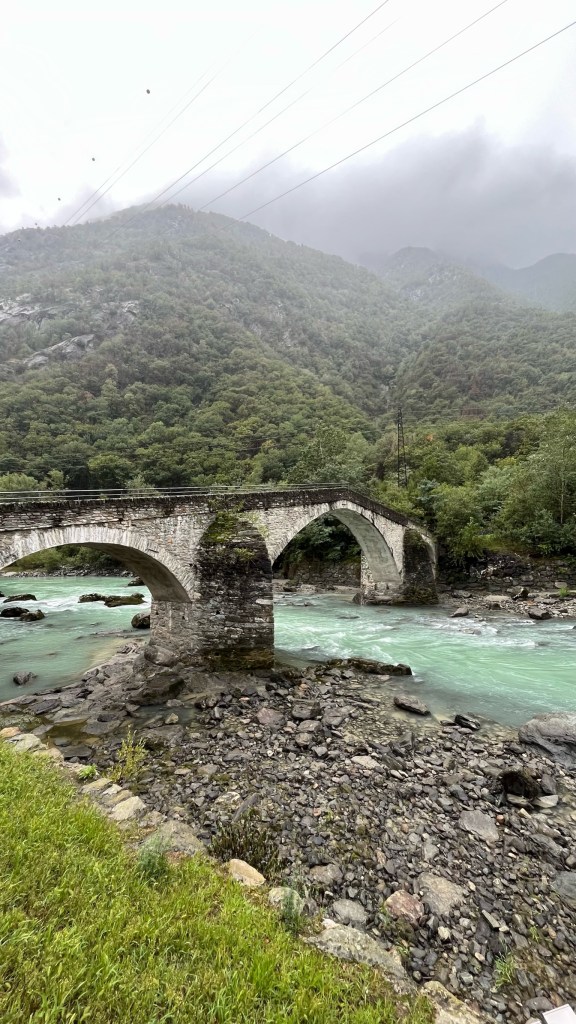
Anyway, I turned back onto brilliant green grass fields, the Goretex in the new shoes holding up relatively well for the time being. I crossed under the main highway, then the smaller highway, and then finally crossed over the river itself on a beautiful 3-arch stone bridge, which was originally thought to be Roman but is actually from the 18th century.
The next stint was not very interesting: a bit of road walking as the road wound its way alongside the base of a mountain, and then a long, straight, path running parallel to the Autostrada. I did pass a large vegetable-growing operation and was impressed by the rows of cavolo nero and other leafy greens. It was starting to drizzle at this point and I was walking straight into the rain — a nice respite from the heat — but I was mostly focused on getting done with this section so I could get away from the noisy road. I listened to a weekly podcast on British politics, which had some interesting comments regarding the limitations of sanctions on Russian oil, and the amount of Russian oil and gas still being sold to European companies. One of the hosts, who had been meeting with leaders of some African countries at a summit, reported hearing claims that Europe was hypocritically imposing sanctions while also creating loopholes to ensure its own oil needs were met.
Soon I was in the completely deserted village of Hone. It seemed to have a few lovely bars and restaurants, but every single one was closed. It did, however, have a few impressive gardeners working on their fall produce: I snapped photos of squash the length of my torso from different backyards.
Above Hone I could see the imposing Forte di Bard, a hilltop fortress protecting this chokepoint of the Aosta Valley. Leaving Hone I crossed the Ponte di Bard into the medieval town of Bard. Like everywhere in Italy, there are many layers of history in this village: it served as a garrison for Roman soldiers in the 6th century; in the 13th century it was under Savoy control and its fortress was used to levy taxes on travelers; in 1800 Napoleon and his 40,000 soldiers which had crossed the pass dislodged the Austrian soldiers who controlled the fortress.
I was starving at this point, but the village of Bard didn’t seem to have any open bars or cafes. So, I headed to the fortress and purchased a ticket — the whole thing was very confusing as there are a number of museums inside the fortress that you can buy tickets to. I thought that a single-museum ticket was the lowest-commitment option, though apparently there is a cheaper ticket just to visit the battlements. Oops.
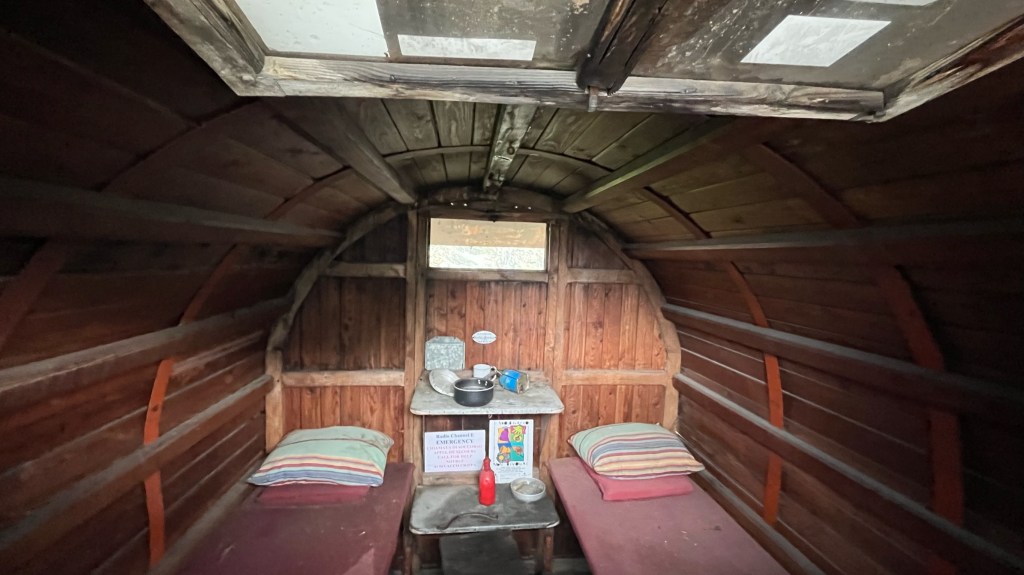
Either way, my ticket gave me access to a series of shaky funiculars that trundled me up the hill to the top of the fort, where I had a coffee and cornetto in the coffee shop at the top. I made a good faith effort to try and visit one of the museums, but after wandering for 10 minutes unable to find an entrance, I gave up and walked down the pedestrian path, which offered fantastic views upvalley. From up here I couldn’t quite see Verres, but could see Arnad. Clouds still covered the mountaintops, and the valley floor glowed green, broken up by colorful houses, the glacial Dora Baltea, and the fast-flowing, brown Ayasse river. On the way down I peered into a mountain bivouac which had been moved here after being taken down from Mont-Blanc, where it had sat since the 1950s before being condemned due to safety issues.
Back down from the fortress, I popped quickly into Bard’s very calm, dark church, but was anxious to get a move on. I followed the path out of town, saying goodbye to the medieval city center, and quickly the road underfoot went from stone to asphalt. It wound downhill in steep, tight curves that were painful on the knees and would have felt treacherous in a car, as the narrow road was lined with cement barriers. Finally on the valley floor, I was happy to walk for a bit by random backyards that abutted the mountains. Unfortunately this path pretty quickly rejoined the main highway, and the return of traffic noise was unwelcome.
However, I knew there was something very cool yet to come. Just before Donnas, I arrived at the well-preserved section of a Roman Road. You could very clearly see the ruts from carriage wheels from over 2000 years ago. And above the road was a perfectly preserved arch carved out of the rock. It was amazing to walk on this section knowing I was treading the exact same ground as other pilgrims and travelers heading to and from Rome, to and from Aosta, to and from the pass.
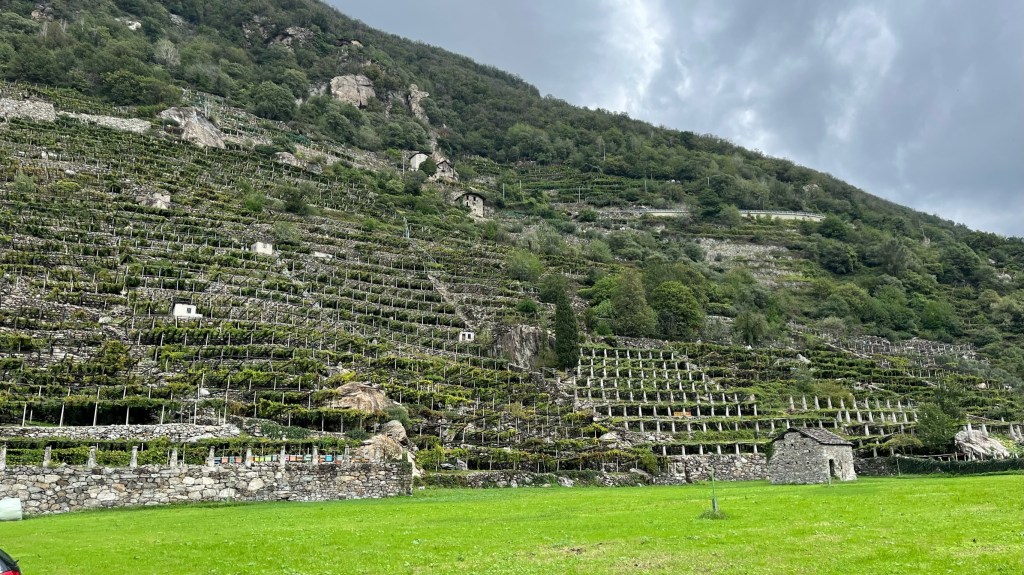
After the arch the trail cut away from the road into the absolutely charming historical center of Donnas, which has a pilgrim hostel and a very nice-looking restaurant offering a pilgrim menu. I wished I could have stayed but it wouldn’t open for lunch for at least half an hour more. So I continued out of this historical strip, to the final stretch of the walk for today. This, unfortunately, was entirely on the sidewalk of a busy highway for 30 minutes or so. I distracted myself by admiring the grapevines planted high on the hills behind the suburb sprawl. Donnas is another DOC region in Valle d’Aosta, which primarily grows Nebbiolo(!) The pergolas planted on steep terraces allow the grapes to ripen more evenly.
Finally I arrived in Pont Saint Martin, where I immediately booked it over to see the Roman bridge, naturally. I stopped in a cafe for a sandwich, and then headed to another bar for a coffee until I could get into the accomodations. At around 2:30 I met up with the owner who let me in and showed me around, and we chatted for awhile about my experience on the Via Francigena and my plans once I arrive in Rome — she was very lovely and happy to chat (and I think glad that I spoke Italian). And the place is very well-appointed. In the end I am sharing a dorm room with two American women, Ann and Leigh, with a British couple in the room next door. The kitchen is well-stocked, and there is a washing machine we all took turns using — little luxuries!
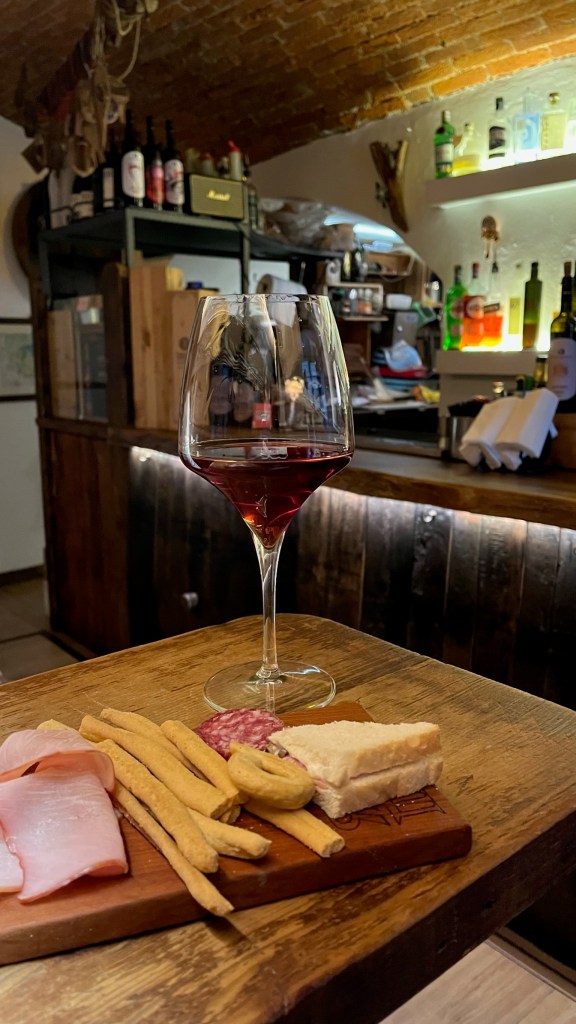
After some chatting and chores, I headed out for a walk around town. I happily grabbed a gelato at a shop nearby. The flavor of the day was “Crema d’Autunno” and was custard with crushed hazelnuts. Delicious. Afterwards I went to an enoteca recommended by the woman running the accommodation where I sampled a wine from Donnas — this was 90% Nebbiolo and 10% autochthonous grapes. It was delicious, and interesting — a much easier drinking than a Langhe Nebbiolo, fruitier, lighter in body, and with smoother tannins. The bar was a cool find, and the bartender was clearly passionate about his wines (I eavesdropped as he poured glasses for regulars, talking excitedly about what new options he had).
I then headed to a local pizzeria (“New York Pizzeria”), where I ran into Leigh, Ann, and their Swiss walking buddy Patrick. The four of us had dinner together — a lovely chance to hear about their experiences thus far. Afterwards, it was back to the apartment and ready for bed.
Final mileage: 8.99 mi (this is confirmation that my phone is underestimating the mileage, since the VF app says today’s stage should be 9.25 miles, plus my walk down from the Fort!)
Walking time: 4h 16m
Elevation gain: 948ft
Accommodation: Casa Margherita, an apartment in town available to pilgrims. I would highly recommend — as mentioned, the apartment has everything a pilgrim needs and is well located near the center of town.








 Eva on the Via Francigena (and beyond)
Leave a comment