
Songs of the day(s):
A Horse With No Name — America: Lukas’s karaoke song
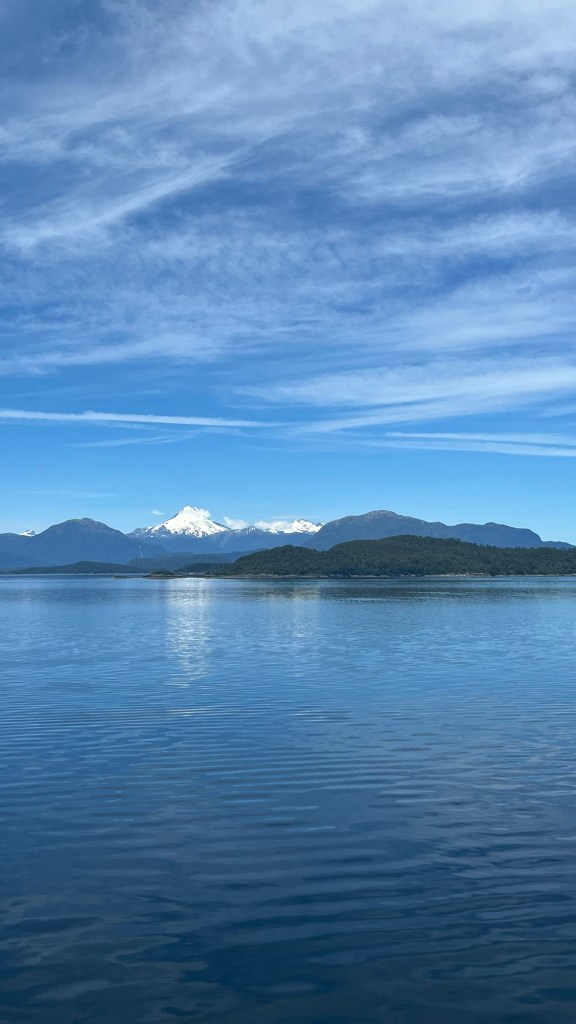
Space Song — Beach House: on one of the few moments I spent alone on the bow, I listened to this as we floated over wide, calm seas and hazy islands, and really felt like we were at the end of the world
I am admittedly delayed in posting these (sorry to my grandmother in particular who I know has been waiting!) Frankly, during four days at sea with no wifi and cell service, I didn’t expect much to happen. Instead, I met some incredible people, spent hours admiring the views, and had a surprising amount of fun. It’s been hard to figure out how to condense it all into one post — but here goes.
Due to the unpredictable Patagonia weather, the ferry departure was delayed by a day. This ended up working out well as I had a day to spent in Puerto Montt preparing – hitting up the Decathlon and grocery store rather than relying on the options once I arrived in Puerto Natales.
The plan was this: 4 days, 3 nights at sea sailing from Puerto Montt to Puerto Natales, a distance of 1100 km (about 700 miles) as the crow flies, stretching from the northernmost reaches of Chilean Patagonia to the heart of the south. We would pass through Chile’s Patagonian fjords, a truly wild and unexplored part of the world, cross the open ocean through the notoriously stormy Gulf of Penas, and hopefully spot whales, sea lions, volcanos, and glaciers. Truly, it would be a journey to the end of the world.
The boat is a working cargo ferry with a capacity of about 250, including Chileans on holiday, international passengers, truck drivers ferrying cargo, and of course the crew and Navimag staff. We boarded around 5pm — still mid-afternoon in this part of the world — where I checked into the 8-person cabin I would be sharing with 5 other women: Lucia, a 22-year-old Danish student doing her exchange in Santiago; Monika, an eccentric German retiree who had seen much of the world by ship; two Spanish sisters in their 50s or 60s; and a French woman of the same age who refused to speak any language other than Spanish. The room was surprisingly spacious, the beds wide and comfortable, and the en-suite bathroom was small but had one of the best showers I’ve had in a while.
Once I dropped my things I explored the boat: the expansive bow from which Lucia and I spotted dolphins and sea lions, the upper decks with benches to sit and admire the view, the stern where you could watch vehicles load onto the ship, and the main deck dining room. We were served a first dinner of beef and mashed potatoes, which I ate with Lucia and Luis, a 60-something from Barcelona I had met while waiting to check in. After dinner, I went to examine the boat’s limited library shelves with Lukas, a Belgian lawyer who is about my age. The books were in a mix of languages, primarily guidebooks with some beach reads thrown in. “What looks good to you?” Lukas asked. I responded ironically, “Well, I was thinking that Birds of Patagonia looked like a thrilling read…” He looked at me quizzically, realized I was being sarcastic, and then laughed. “Jokes on you,” he said, “I fucking love birds — I’m going to take that one.”
After dinner Lucia, Lukas, and I went to the stern to watch the boat push off. Lucia expected a “Chilean delay” and correctly predicted that we would leave 2 hours behind schedule. As we slowly navigated out of the Puerto Montt harbor, the sunset began painting pink and orange stripes on the sky, spotlighting two snow-covered volcanos on the horizon. The three of us chatted and joked as the sky darkened and we picked up speed, discussing our plans for Puerto Natales (all 3 of us were headed to Torres del Paine, them for the O-trek and I for the W-trek). Inexplicably, Lukas explained that he had brought 3 emergency blankets along for his trek, which had Lucia and I doubled over in laughter (a theme that would emerge for these days) asking how many times he expected to be in life-threatening danger on an 8 day trek. We continued to chug along southward, joined by Kostas from Greece, as stars emerged and the wind picked up. Finally, it was time for bed in anticipation of our first full day at sea.
In these types of things, I’ve found that little groups, mini traveling families, form quickly. By breakfast the next day ours had started to form around a core group of solo travelers: myself, Lucia, Lukas, Luis, and Kosta; Satoshi, a young Japanese guy who (amazingly) had so far survived traveling South America sleeping in gas stations and bus terminals without incident; Alain, a Frenchman and sailor. We were intermittently joined by Sergio, a Colombian digital native traveling Latin America by Vespa; a Swiss couple named Andres and Jenny who were the best wildlife spotters on the boat; and Tomas, a Berlin tour guide who regaled us with stories of when the wall fell (and who spoke Spanish well enough to join the truck drivers for a game of dominos).
The first day we were blessed with basically perfect weather: flat seas, warm sun, and a bearable (though strong) amount of wind. Lucia, Lukas, Luis, Satoshi, and I spent the morning on the bow watching rows of mountain silhouettes and the occasional white-capped volcano drift by. Later in the morning the full boat joined a sunny yoga session on board, and then our core crew returned to the bow to nap in the sun on our sleeping mats. This plan was short-lived, though, as we were quickly called over to see the wildlife as we passed more glaciers: seals happily jumping short arcs in and out of the water and lounging in the sun. Lucia and I were glued to the guardrails alongside Kosta and the Swiss while Lukas ran inside to get his binoculars. “Hurry,” we joked, “maybe you’ll miss a whale!” This was a joke because we were certain that we wouldn’t be luckily enough to see a whale, as most journeys promised whale sightings and delivered none. But, lo and behold, 30 minutes later I spotted something dark on the horizon. Lukas still had not returned, though Lucia and I shouted for him to no effect. Jenny pointed out to the further distance, and we watched in awe as we could see the tiny but unmistakable shape of a whale’s tail rise above the water and splash down. I hadn’t expected to care so much about the wildlife spotting, but found myself jumping up and down with Lucia, whooping with joy.
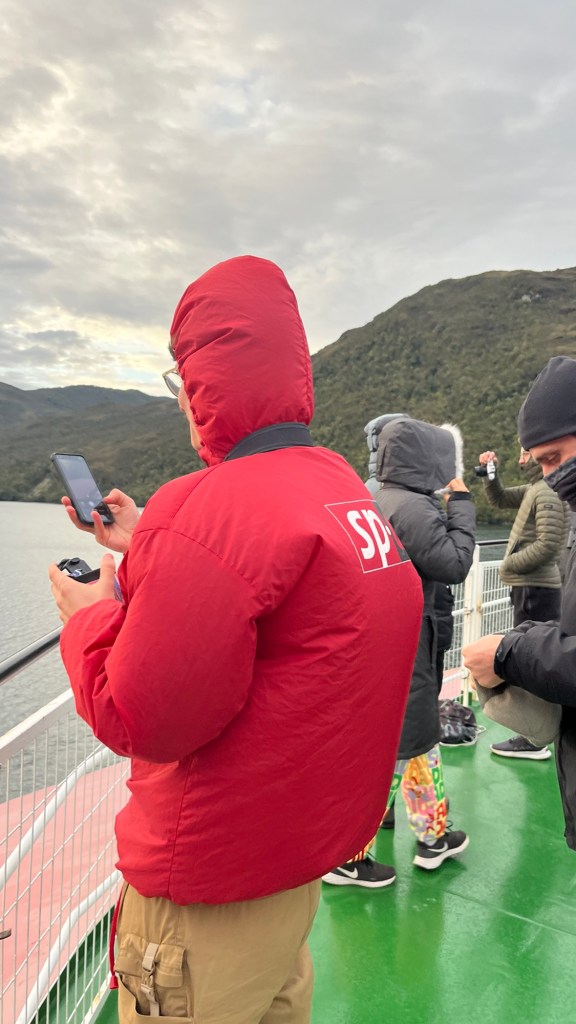
We spent the rest of the day on the bow, watching for more wildlife. Andres and Jenny saw penguins, though I missed them. More seals popped up alongside the edge of the boat, jumping and rolling in the sun. In the evening the wind picked up significantly, blowing up Lukas’s vintage rain jacket like a balloon — hood and all — while he watched for birds, leaving Satoshi, Lucia, and I breathless with laughter. We continued to mess around as we scanned the skies and waters — jumping up to see how far back the wind would push us, joking about any and everything. At one point we all became absorbed in trying to identify a bird flying alongside the boat, absently noticing a commotion amount the others along the port guardrails. Finally Andres snapped us out of it, “Guys! Dolphins!” and we excitedly turned our attention to three dolphins jumping through the boat’s wake, laughing about how misplaced our focus had been.
The clouds descended and it got dark without a sunset, but Lukas, Lucia, and I wanted to wait until the much-anticipated “open ocean” navigation before going in. We waited in the strengthening wind as the bow rocked up and down, watching the last strips of land disappear, pointing out distant lighthouses and gazing into the expanse before us. Soon though, it too dark to see, so we retreated inside. Lucia and I spent another hour or so playing cards with Ted, a Canadian retiree (I assume) who was driving up the length of South America with 3 buddies. The boat’s rocking intensified as we stumbled back to our cabin, and I lay awake for awhile listening to the creaking of the ship as we rolled through open ocean.
It was a rocky, fitful night of sleep for the whole boat it seemed, as breakfast the next day was noticeably emptier. Outside the dining room windows you could see grey clouds hanging low, massive ocean swells, and rain driving down. As the boat rocked back and forth, sky and then sea would rhythmically disappear. Sergio used the level on his phone to measure a 12 degree tilt. We spent the morning inside — Satoshi pretending to be a waiter as he ran back and forth to grab tea for everyone’s coffee. I taught everyone how to play 500 rummy and we spent a few hours playing — each round someone new would want to join so I’d deal them in and explain the rules again. After a few hours (and victory by yours truly, naturally), we broke for lunch and then much-needed naps. By the afternoon we had left the open ocean and the water was still enough to allow to for a visit to the bridge, where we were surprised to find no captain! We investigated all the equipment, careful not to touch the auto-pilot, and then headed back to the bow to watch rocky islands drift pass. We watched the Chilean albatross (ceja negra) as it would run across the water like a plane down the runway, before gracefully taking off and floating up on the air currents. Our resident bird boy Lukas quoted a character from a Disney film: “Albatross Airlines…almost always arrives” and said he was happy to go back to Belgium now that he’d seen so many good birds.
We retreated back to the dining hall for more cards, this time a game called whis(?) that has many iterations. We learned the Danish way from Lucia and took turns betting on how many hands we would win. The projection screens in the dining hall announced karaoke as the evening’s activity — sign up at reception. We joked about making the game’s loser do karaoke, talked about our singing abilities (I did quite a bit of bad karaoke while living and traveling in Asia) and how many glasses of wine we would need to participate. Alain, sensing his moment, piped up: “exactly how many glasses of wine would you need to sing karaoke?” Now, it’s important to note that alcohol is forbidden on the Navimag. Apparently this is due to some passengers getting drunk and somehow starting a fire (probably by smoking) a few years ago on the older boat, according to Lucia. Naturally, we are rule following people, so when we signed up for karaoke and headed to Alain’s cabin for an aperitif it was certainly only to consume Chile’s finest unfermented beverages.
And that is how I ended up singing karaoke on a boat floating through remote South American fjords. I kicked it off to a crowd of 10 or so with a half-Spanish/half-Italian rendition of the Gipsy Kings cover of Volare (after which an Italian woman forced me to prove that I actually did know the correct lyrics of the Italian version). Lukas followed with A Horse With No Name, then Luis with Quizas, Quizas, Quizas. Satoshi sang a Japanese ballad and then accompanied Lucia on the ukulele while she sang Mamma Mia. Alain rounded it out with Somewhere Only We Know. Then the group of us got up, crowded around the one microphone, and danced our way through Tequila by The Champs — almost missing our cue to sing the song’s one lyric because we were laughing so hard. Somehow this display had drawn a crowd, and one by one other groups began to join in. Lucia and I did one version of Dancing Queen and then handed the mic over to a Navimag staffer for a Chilean pop song. The session continued for almost an hour, with more of the staffers and Chilean travelers (who had kept apart from the internationals for the most part) began joining in. One family covered a Chilean rock song together, another teenager sang a song I think about a cat being caught in the rain. The whole experience was equal parts sweet and hilarious, watching the fjords pass by out of the windows while we sang together, off-key, in languages we didn’t speak.
I emerged after karaoke to go back to the bow for fresh air. Luis, Lucia, Lukas, and Satoshi all joined at various points. We were exiting a channel and would be skirting along the open ocean again before heading to more narrows for our final day. The sea was wide and flat, the only signs of civilization the distant blinking of a lighthouse. I turned back to the boat and watched it steam forward, looking a bit like a Star Destroyer from Star Wars. It reminded me a bit of the movie Triangle, a creepy film involving a boat and a time loop. I shuddered at the thought and focused on the sky. The remnants of sunset clung to the horizon — just a faint line of magenta as a dark blue settled over the rest of the sky. The others eventually headed in and Lukas and I laid down to identify the planets and constellations that were slowly emerging. Harder than it sounds also because everything in the Southern Hemisphere is upside down, so constellations are harder to identify. Before heading to bed, I did manage to pick out Orion’s Belt — which always reminds me of home.
I started the last day of the journey, where else, on the bow of the boat. It was bitterly cold, windy, and rainy so I was alone for the first time. I listened to music and watched the scenery pass by. Like the night before we were outside of a canal near wide open ocean. The last 12 hours had really driven home just how far away we were from everything. The only boat in sight, surrounded by islands not inhabited by any mammals — the territory of only birds and insects. Hard to even comprehend. I had never felt so far away from everything before — once again having the almost-creepy feeling that the world could have ended and we wouldn’t know, that we could be the only boat out here, steaming along into the nothingness.
Inside the dining room the vibe was not nearly as nihilistic — we would arrive at 3pm, about 7 hours earlier than expected, so over breakfast we were briefed on the preparations for arrival and sent off to pack up our cabins. That done, we headed back outside and watched distant glaciers, borrowing Kosta’s binoculars (much better than Lukas’s though only 10 euro more at Decathlon) to inspect the blue-grey craggy ice. Finally we entered a narrow canal — I’d been waiting excitedly for the narrow navigation — and could see rocky cliffs and new vegetation up close as we drew past. Once again we were on the wildlife lookout, watching albatross soar and then excitedly shouting to each other over a group of penguins sunning themselves on a faraway rock. Luis had to break the bad new to us that they weren’t actually penguins — the zoom on his nice digital camera proved it. Freezing cold and hungry we headed in for lunch, our last meal on the boat. Lucia and Lukas had two servings of pasta (“this is dinner for tonight!”) and stocked up on necessities for the trek: Lucia grabbing mayonnaise packets for sandwiches and Lukas filling his chest pocket of his sweater with instant coffee. Luis taught Lukas to play chess by playing first just with pawns, then slowly adding in additional pieces. We tried to figure out how to cover a full half of a chess board with one knight without backtracking, but couldn’t figure out the trick. Lukas handily beat me in pawns-only chess and I decided it was time to go back outside.
The sun had emerged when we returned to the bow. Suddenly, we were back in sight of civilization. We could see more glaciers and snow capped mountains, but also many cargo boats passing by. Soon we re-entered an area with cell service — I put my phone on airplane mode to stave off the barrage of notifications for a few more hours. Then Lucia, Lukas, Satoshi, and I propped ourselves up on the bow and napped in the strong Southern sun (the ozone layer is particularly thin here…) for the last few hours of the journey.
And then, we were arriving. The whole boat crowded along the guardrails as Puerto Natales came into view, larger than expected on the flat expanse just south of the mountains. We exchanged contact information and bid each other well, and I called my dad to update him that I had arrived. There was more excitement as we moored since one of the mooring ropes snapped, delaying us as we waited to disembark. A few minutes later, those with vehicles were shepherded to the side and us foot travelers headed to the cargo hold. We slung our packs onto our backs and waved goodbye to the ship, pausing for one last photo before the staff shooed us away to make room for the trucks. And so the group of us, laden with backpacks, jackets, and one broken ukulele, meandered our way into Puerto Natales, waving goodbyes as each one peeled off for their hostel. I was staying close to the port so bid the group an early goodbye, promising to meet the next day for lunch and pre-trek shopping.
I was pleasantly surprised — shocked, even — with how fantastic the experience was. The people, the weather, the views, and even the cabin and food were so much more than I expected. Armed now with a ragtag group of new friends and an America song stuck in my headed, I started to prepare for the next stage of my trip: 5 days of trekking in Torres del Paine national park.




 Eva on the Via Francigena (and beyond)
Leave a comment