Song of the Day: Meet Me in the Woods — Lorn Huron
This is serious stomp-and-clap, lumberjack-beard-but-lives-in-Brooklyn outdoor indie music. However, it is very much fit-for-purpose for these sorts of situations, you know?
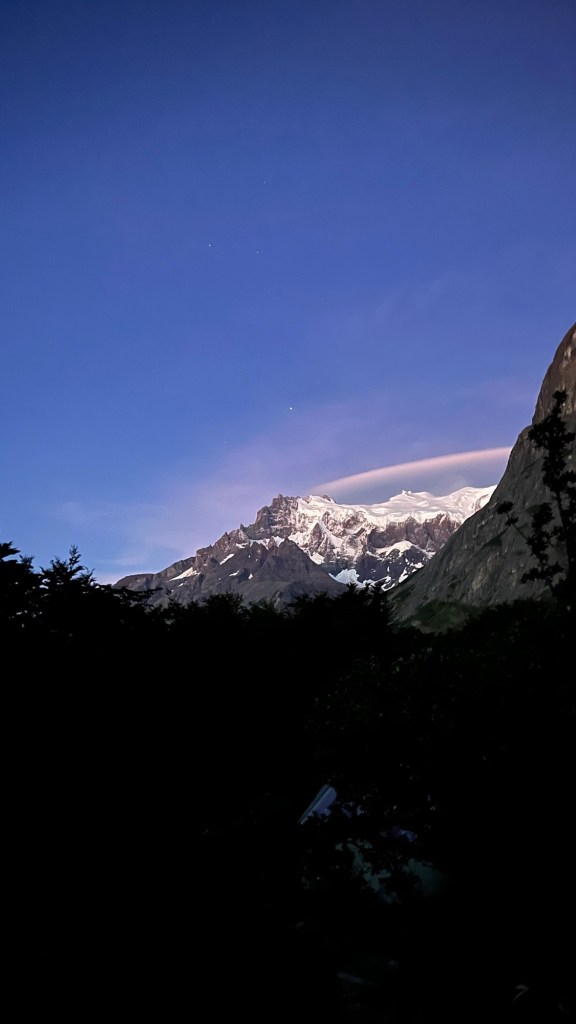
A very painful 4:45 alarm went off this morning, which I snoozed to 5am with a groan. Even so, I was up before sunrise, stumbling in my sandals to the main camping area to brush my teeth and make my oatmeal. There, in a clearing between the trees, I had a view to a few stars clinging on as the sky lightened. The white snow on Frances glacier seemed to almost glow against the deep blue sky. I smiled to myself as I ate the first half of my breakfast, before deciding to save the rest for the trail. I returned to my tent and quickly packed up, triple checking that I had not missed anything in the dark. Then, with some effort, slung my pack onto my back, grabbed my poles, and headed off on the trail towards Frances Refugio, the first waypoint on what was going to be a long day.
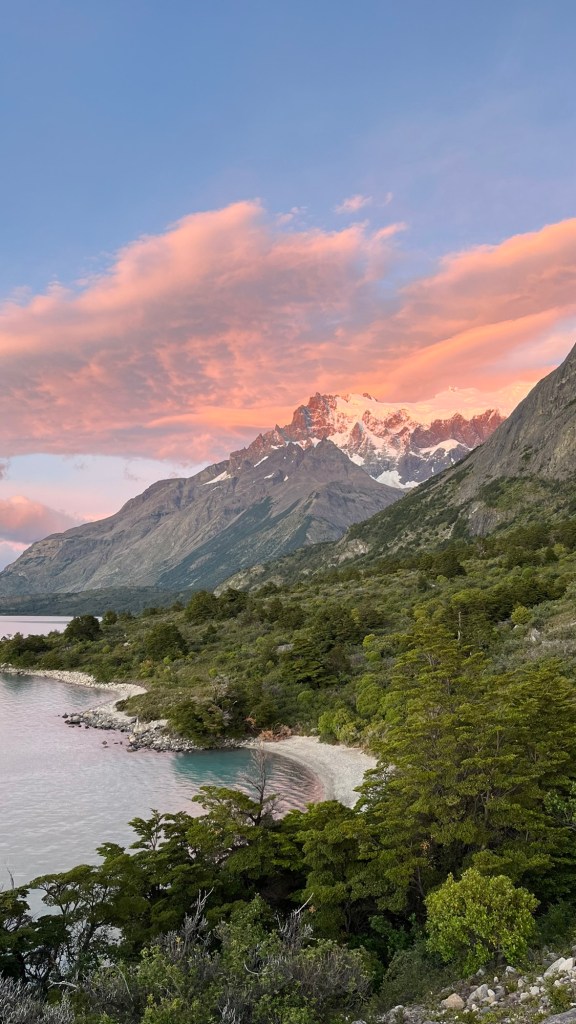
It was exactly 6am when I set off, at which point the sky had already brightened considerably. I could navigate now in the woods without a headlamp, and at any brief clearing I would crane my neck to catch views of the glacier ahead of me, and the thin pink and orange strips of light emerging across the lake. Above my head, wisps of cotton-candy clouds glowed magenta. It was a glorious pre-sunrise, and I stopped every minute (literally, by the time stamps on my phone) to snap photos and take videos. As the sun angled higher after a few minutes, the thick cloud behind the glacier was suddenly radiant, transforming from deep pink to clementine. It reflected the color back onto the snow atop the glacier, rendering the mountaintop almost angelic. Below it, the lake began to turn turquoise again, contrasting beautifully with the clouds. I was stunned. I’m not much of a crier (no, who am I kidding?…I’m not much of a happy crier), and yet I felt warm tears welling in my eyes, and not just because of the morning chill. I stopped on a rock to stare, mesmerized, at the view while finishing off my breakfast.
Once I continued onward, the trail brought me down to a rocky beach on Lake Nordenskjold. Suddenly, the sun crested over the horizon, bathing Los Cuernos above me in golden light. Once again, the snowy glacier glowed in stark contrast to the lush forest below. I kept walking, stumbling as my eyes were glued to the scenery and not the path. I left the beach, rejoined the forest, crossed a stream, and emerged on another beach, still transfixed by the views above me as the light gradually transitioned from golden to white.
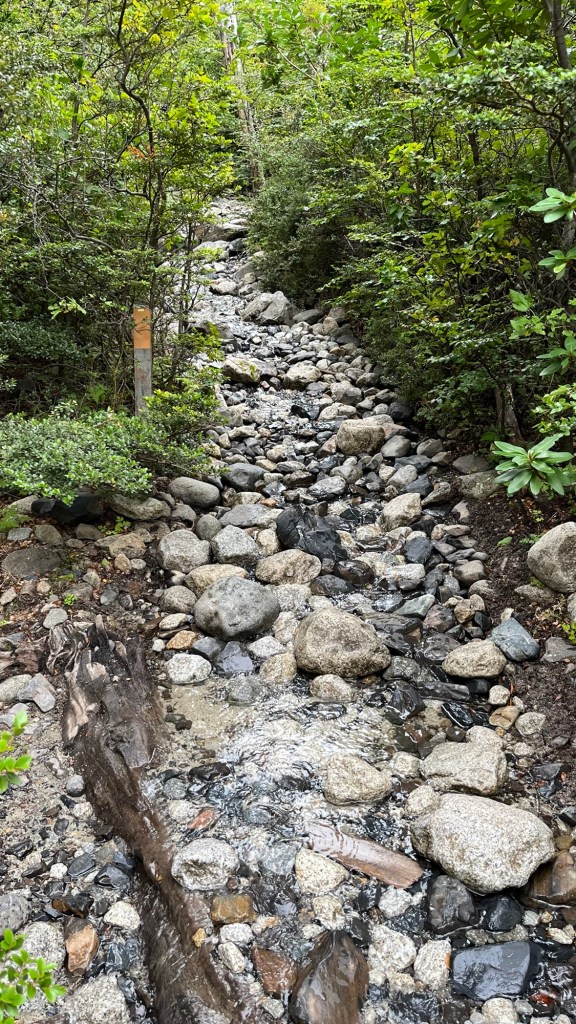
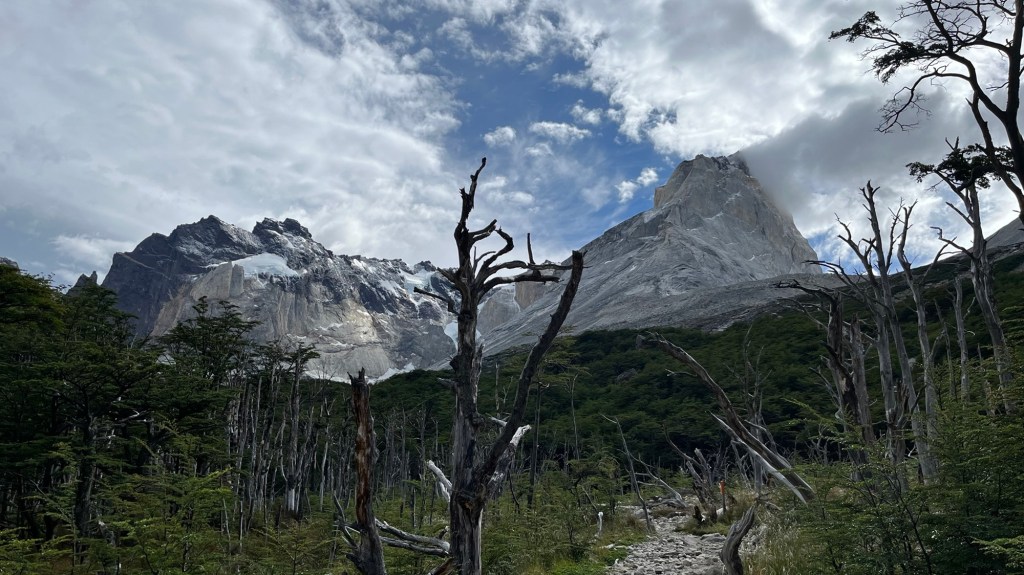
The trail curled upwards through forests and clearings, and I watched the glacier creep closer. I had been told it would be an 2 hours to Frances, though in the end even with my scenery breaks I finished the walk in about an hour 45, stopping quickly for another snack before continuing along the 20 minutes or so to the Italiano ranger station. There I dropped my pack and pulled out my day pack (much lighter this time; I learned my lesson from Day 1) and set off. I meandered through a forest past the remains of what had been a state-run free campsite but has been closed since Covid. A gradual uphill through the woods emerged to the first mirador of the day: a series of big boulders on which you could see up close the face of the Frances glacier. I met two women in their 50s or 60s (Sherry and Silvie) from the US, snapped their photo, and took off after them. From here the character of the trail changed considerably, from a gentle uphill amble to more serious climbing. First, a series of steep and rocky pitches, where I occasionally had to ditch the poles and pull myself up with my hands. Some of these had water flowing down them as well, like yesterday’s trails. I got through this section and continued back into the forest, now a steeper section where I was struggling for breath while pulling myself up the rutted paths. I stopped for a quick break and met Justin and Jess, two travel instagrammers who were also doing the W in my direction. I offered them some of my mango, quickly solidifying a friendship. We discussed the thunderous sounds of avalanches and ice falling from the glacier, which we could hear but not yet see — we had to see one once we reached a viewpoint.
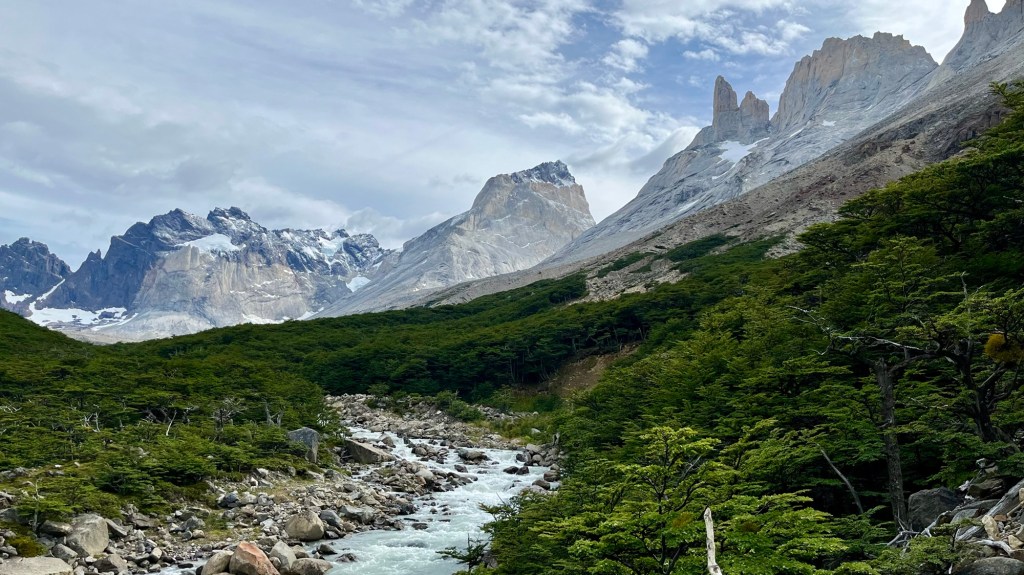
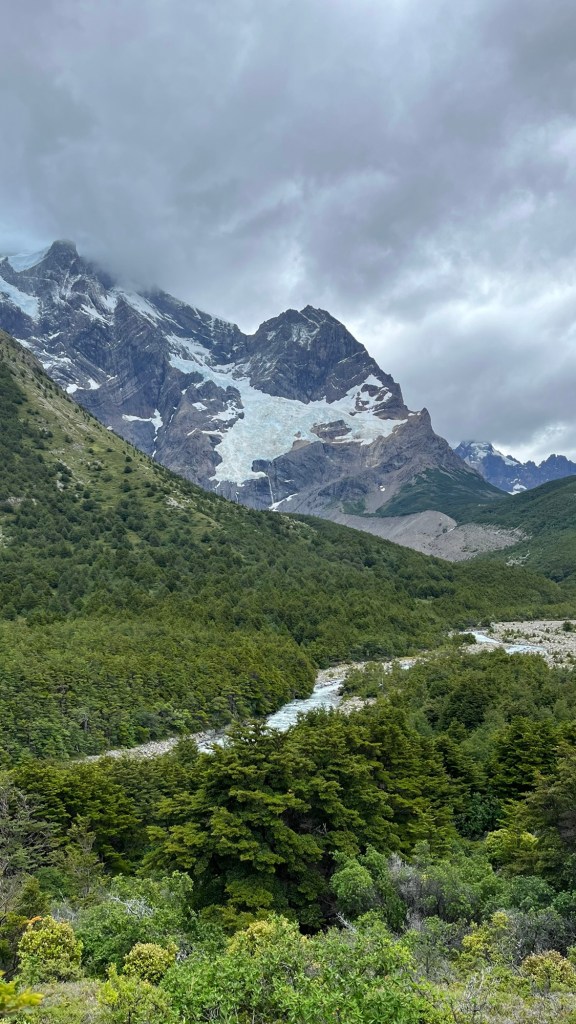
By this point I was close to the Mirador Frances, the first of two major stopping points on this trail. Many people get to this lookout and decide they’ve had enough, especially if they are also coming from Cuernos to Paine Grande (going all the way to Mirador Britannico makes it a relatively long day with all the elevation). It should be no surprise that I had already decided I was going all the way barring terrible weather conditions. And while it was grey and cloudy, there was no wind at all and so far no rain. Still, I ended up staying at Frances longer than expected, as I got to chatting with the people around me on the trail: Victor, a Dutch guy about my age who worked in marketing; Marek, a Czech now living in San Francisco; AJ, a nutritionist living in Austin; Tim, an American teacher who had emigrated 30 years ago to Switzerland, and his daughter Camille. After watching a number of small avalanches (unfortunately I never got to see a “big one”), we set off as a group. Victor and I walked together for awhile on a flat section winding through a thin forest. We followed a rushing river, and a few gaps in the path allowed us to gaze out to vs of the river and glacier. As we started to get more gradient (a number of steep down-and-uphills as we crossed creek beds), I slowed down to protect my knees, Victor stretched out ahead of me, and soon I was alone again.
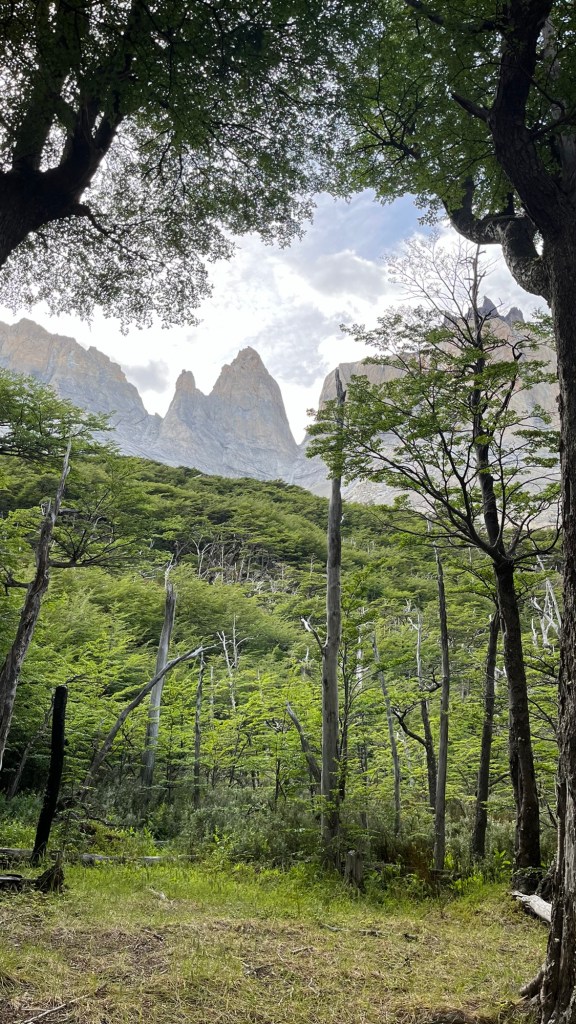
After awhile walking in the woods, I suddenly emerged onto a massive, empty boulder field, presumably the remnants of a long-ago landslide. I spun in circles, transfixed — around me were almost 360 degrees of tall mountains, from thin towers similar to those from Day 1, to imposing glaciated masses. Below the bare stone, lush forest sounded in all directions. Then it was back into the forest again, occasionally able to catch glimpses of the mountains the the trees, sometimes framed above the rushing icy river. I passed through a few more clearings, crossing streams over loose wooden boards, and walking through the gnarled, charred remains of a burnt section of forest. I was starving by now and looking forward to the lunch I had pre-packed, and hoped a I was close to the final Mirador now. A hiker coming in the other direction assured me I was, and ten minutes later I was once again scrambling up hands-and-knees to a large rock that emerged above the trees. I climbed up to a good lunch spot and took in the view of dark green forest and massive grey peaks all around, with views back to the lake behind me.
In the end I stayed at the Mirador for an hour. I had more tortillas and salami and chatted for a long time with Tim about his life in Switzerland and my decade-long dream of moving to Europe. He joked how he did it the “easy way” by marrying a Swiss woman, rather than getting visa sponsorship for a job. We talked about American culture, our reasons for wanting to leave, and how our priorities felt different from many back home. He was an interesting guy and I was excited to hear about his other travels, from Nepal to Honduras, as well as his Swiss life. He reminded me a bit of my buddy Patrick from the Via Francigena. I also met Luigi, a 76-year-old Italian climber (not professional, but close, he told me) who was fulfilling a life dream to see the Patagonian peaks.
Finally, I decided it was time to continue on and get a start on the second half of my day. So, I gave up my perch, carefully picked my way downhill (with complaining knees once again), and began retracing my steps, stopping periodically to snap photos and cheer on those coming in the other direction. Just before Mirador Frances I ran into Marek again, sitting on a rock with a fantastic view of the glacier. I joined him, using the opportunity to have another snack and inspect the glacier up close with the zoom on my camera. We chatted for awhile before he continued on and was replaced by a Dutch guy named Maarten, who I recognized from my first day since he was hiking in jeans (he swears they are comfortable). He too was headed to Paine Grande, as were two Korean men sitting near him, who offered us oranges — likely desperate to get rid of extra weight they had carried too far. I got up to leave but ran into Luigi again, so stopped to chat with him for a bit, get some advice on my knee pain (probably inflamed tendons, he figured) and then much more slowly begin to wind my way down the very steep, very slick rocks. At this point the pain in my right knee was quite sharp, and I was mostly focused on 1) getting back safely and 2) reaching my pack as quickly as I could, where I could grab my knee brace. So I carefully slid my way downhill over gravel until reaching the forest again, where the path flattened out and I could walk semi-normally with no limp.
Soon enough I had returned to Italiano and was reunited with the rest of my stuff. After taking a quick break to re-organize my stuff and grab more water, I set off, waving hello to Maarten who was also putting on his pack. The path curved right coming out of Italiano, up a short steep section and then looking back to expansive views over the imposing, two-toned Cuernos and the glacier I had spent much of the morning admiring. I meandered up high above the river, crossing over a shaky suspension bridge, and then continuing on a rocky path between shrubs. The Korean men walked behind me, and one named David told me about his life — he’d moved from South Korea to New Zealand decades ago for work, but had plenty of advice on good hut-to-hut hikes in Korea for when I have the chance to visit. He was very nice, but I was tired and not much in the mood to chat, and I soon was out ahead of them.
The path here was flat, mostly, even if the loose rocks made walking still painful on my knee. It was a long day, and I also hadn’t done much today in terms of blister prevention — and I could feel my feet starting to hurt. But I pushed onwards, out of the shrubs and into a massive petrified forest. Almost 15 years ago, a tourist had started a massive wildfire after burning toilet paper — in the end, 17 hectares of the park burned. This section was one of the hard-hit areas. The path was surrounded by contorted grey trees, and you could see the line on the mountains of where the fire had impacted — a clear divide between grey and green. Some small shrubs and dandelions had started to recover, but most of the trees had been hundreds of years old. In my lifetime, this section will always show the scars of the fire, a stark reminder of the consequences of human behavior on our planet. The somber environment, combined with the lack of wind that had honestly become a bit eerie, not even a breeze after days of big gusts, compelled me to find a spot to stop. There was a mirador up ahead but I wasn’t sure my aching knees and pinched heels would make it all the way up the hill, so when I found a good rock by the side of the path I decided to stop there. In the end it worked well — I was only 50 meters or so from the mirador, but avoided the crowds gathering there. I sat for awhile with my boots off, staring at the mesmerizing reflection of the Cuernos in the flat, mirror-like Lake Skottsberg. A few other hikers passed me and stop to chat. One guy asked if I had food, and seemed surprised when I offered him some dried mango. My good deed for the day, I guess.
When I set back off, I was joined by a twenty-somethings Australian couple who had been living in Canada. We walked together talk about our other Patagonia travel plans — everyone here is criss-crossing the region in similar ways. As we crested the hill we had been walk alongside, the Cuernos temporarily disappeared behind us and a new mountain appeared — this one the Paine Grande massif, I think. The scenery had changed, gradually over the course of the day, but dramatic now in comparison with the views near Refugio Cuernos. Lake Nordenskjold was long gone, as was the glacier and the forests. Ahead were rolling, grass-covered hills that could have been mistaken for Connemara in Ireland. I continued on while the Australians paused, ready to get to camp and drop my stuff. Out of nowhere, the wind reappeared in a big way, blowing my hair in my face as I trudged along, singing quietly. I’ll admit that in this point of the day, with all but 2 of my kilometers walked, I was ready to be done. While the scenery continued to be stunning, these past days had been such a visual feast that I was struggling to fully appreciate the less-dramatic beauty, especially in my exhausted state. I felt a bit guilty about it, and tried to focus on being present and appreciative. After more rolling hills, I finally crossed a stream, emerged from a small stand of trees, and caught my first sight of the brilliant blue Lake Pehoe. It was cloudy today so the lake was not as turquoise as it normally would be, but nevertheless the color was shocking. I could also see the large Paine Grande Refugio complex further along the lakeside, tucked beside a hill. I pointed myself in that direction and trudged along, leaned over to manage the wind.
For the next two nights I would be staying in dorm rooms rather than tents. This side of the park has refugios run by a different company than the eastern half (Vertice vs. Las Torres). Over here is cheaper in general, and the pricing is different, so dorms here were cheaper than the pre-pitched tents. I was sharing my room with Sharon and Graham, a sweet pensioner couple from the UK who were traveling for a year, and a Chilean guy who lived in the US. He did not speak English and was a thrilled about my very broken Spanish, so eagerly sat with me through a very broken conversation about where I’ve been living.
Once I’d had a shower, I limped in the direction of the camping area, where there was apparently hot water available to make my dinner. There I ran into Maarten, who was cooking bolognese on his freshly-rented camp stove. We had an aperitif together cobbled from our provisions — it was his last night so he was looking to get rid of excess peanuts and bananas chips. Using only hot water, I managed to make what felt like quite the gourmet meal — couscous cooked in soup from a single-serve soup packet, with chunks of salami and a bit of Parmesan cheese mixed in, and some cheese reserved for Maarten’s pasta. Afterwards he and I grabbed beers and sat on a picnic table outside to chat. He has a super interesting job advising the Amsterdam city government on large projects — a mix of engineering and broader social engagement. “I like that everything I’m doing, I feel I’m doing it for my neighbors,” he explained. Plus, it was project-based so offered good variety. I was fascinated, so we talked about one of the projects he worked on regarding how the city’s canals can be maintained and used by logistics companies. Super cool.
Marek came by as well to say hello and discuss the plan for tomorrow. I was heading out earlier than both of them — I like sunrise walking. Both of them would not stay in Grey, so needed to walk there and back in time for their afternoon ferry across Lake Pehoe. Maarten wanted to make sure he got to Grey and the mirador just beyond the Refugio — fully completing the “W” per the All Trails map. Marek was beat after a long day and unsure if he’d turn around at the halfway mirador — the first sight of Grey Glacier — or push on to the Refugio. I told them I would hopefully see them both at the Refugio, and then bid them goodnight.
I headed back to my room to get ready for the day ahead, apologizing to my dorm mates for my early alarm. No worries, the assured me, as the Chileno was planning to get up and leave at 4:30. So I wasn’t even the earliest bird. The others in the dorm hadn’t come back yet, probably eating dinner in the large cafeteria. Paine Grande was much larger than Cuernos, and like Central is the first Refugio next to a park entrance. So, it was full of all sorts of people — day trippers, people just arriving to the park, W- and O-trekkers heading East, W-trekkers heading west. As such, it felt more crowded and less cohesive compared to smaller Refugios where everyone had already walked at least a full day, and was on a similar early-to-bed, early-to-rise atmosphere. I climbed up onto my top bunk (the downside of a late arrival and long day), navigating where I could place my valuables so they wouldn’t fall down in the night. The top bunk was high and had no guardrail, and while I’ve never rolled out of a bed before in my life, I was worried about accidentally rolling off while zipped in my sleeping bag. I ended up opening up my sleeping bag like a quilt, and laying as close as I could to the wall just in case. With my knee throbbing, and feeling like I’d lived multiple lives just over the course of the day, I quickly fell asleep.
Distance walked: 28km / 17.4mi
Elevation gained: 1083m / 3553ft





 Eva on the Via Francigena (and beyond)
Leave a comment