
Song(s) of the Day: Don’t Think Twice, It’s Alright — Bob Dylan; Welcome Home, Son — Radical Face; Who Loves the Sun? — Velvet Underground
El Chalten is a small village nestled at the foot of the mountains, founded in 1985 as part of a border dispute between Argentina and Chile. The founders of Patagonia and North Face came here on a climbing trip when they were younger, leading to the latter purchasing vast swaths of land in this area for conservation. The village today is a mix of ramshackle corrugated-tin houses and more sturdy restaurants kitted out with faux-Alpine wooden interiors. Most of the lodgings are hostels, most of which were full when I arrived in the peak of high season. On clear weather days, which are not necessarily common even in summer, the imposing and iconic peak of Mount Fitz Roy (the inspiration for the Patagonia logo), looms over the town calling hikers and climbers into the hills.
It was nearly dusk when I arrived from El Calafate, and the mountain was obscured in a layer of clouds. However, the next day’s weather was supposed to be fantastic — the best in almost a week, according to everyone I met who had been here for multiple days, sitting and waiting for a good weather window. So, it made sense to do a big hike on my first day, even if I was exhausted and really just wanting to sleep. I grabbed snacks — bananas, yogurt, saucission, a bit of chocolate — from a the first grocery store in town and almost fell over when I learned the total was almost $20. Toto, we aren’t in Chile anymore. Then it was off to bed early — or trying to, but a group of Argentinian hikers was up chatting loudly until the late hours.
Another thing to add about El Chalten: for years, it benefited from being a cheaper alternative to Chilean Southern Patagonia and Torres del Paine, which is both extremely well organized and very expensive. Travelers could cross the border and come to Chalten, stay in a hostel, and see fantastic scenery on a series of day hikes freely accessible from the town. However, in the last year (really, in the last 6 months or so), that had started to change. While Argentina’s currency fluctuations have stabilized, inflation has hit hard, and prices in town are comparable to those in Chile, if not higher. On top of that, the government had very recently introduced a $45 per day fee for entry to trails that had been free to access up until the end of last year. Compare this to Torres del Paine, where I paid about $45 for 5 days access to well-maintained park with good amenities (public bathrooms, showers at campsites, etc.). Not a favorable look for El Chalten, and a risk for the local economy. Locals knew it too and so a minor rebellion had begun to foment: businesses posted signs opposing the new fees, and it seemed every international tourist was instructed immediately upon arrival on how to avoid the ranger checks — typically, this just meant starting your hike before the rangers showed up to their posts at 8am. The worst part of the whole situation was that every backpacker I spoke to, myself included, would have been happy to pay a reasonable amount to enter the park — but the fees being so exorbitant led everyone to avoid them entirely.
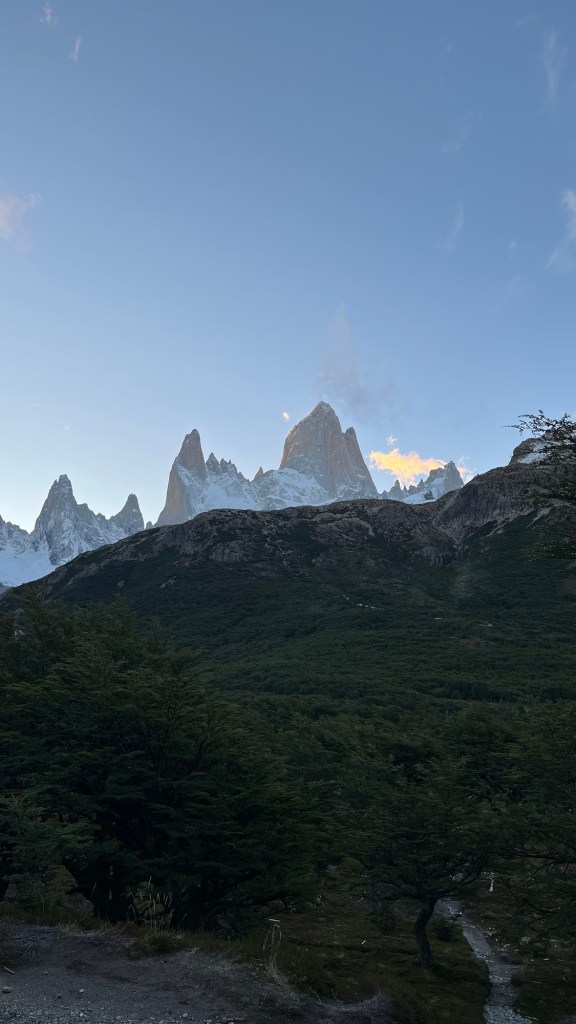
Anyway, all this to say that even after sleeping poorly I was still up at 6 and dragging myself out of town to the trailhead for the Loma del Pliegue Tombado hike. It was a frigid but clear morning, and I found myself stopping every few strides to turn around and watch Fitz Roy bathed in golden morning light, a few puffy clouds clinging to its summit (for a long time, people thought it was a volcano since it almost always has clouds at its peak). I met two Belgian trekkers and together we found the trailhead, skirted past the empty ranger station, and began the walk.
Most advice will tell you to use your best weather day in El Chalten for Fitz Roy (also known as the Laguna de Los Tres hike). Maybe I should have done this, but Lucia and I had agreed to camp together and do Fitz Roy when she got to town a few days later (Navimag friends are for life!) Thinking it didn’t make sense to do the same hike twice, I picked this one, which is apparently only good on clear days, and offers views of both Fitz Roy and Laguna Torre, another major hike. So, in the morning sun I warmed up as I climbed up a gradual slope, listening to two cows in dialogue, mooing back and forth across the hills.
The path continued uphill, eventually flattening out at pasture where cows grazed lazily. I often wonder if birds have any sense of beauty — the thought strikes me every time I see them flying high above Italian hillsides. Today, I wondered the same thing: did these cows realize how good they had it? Chilling on high green pastures in front of one of the most famous views in Argentina, given free range to impede hikers? The many, many cows I met while crossing the endless fields of northern France on foot would be jealous of this life. Left with this to ponder, I followed the trail up through an open and airy forest and to another pasture. Then, more forest before the final ascent: scrambling over rock and slate above the tree line over a series of “false summits” before finally arriving at the viewpoint. Over the rocky peak I had a panoramic view across the Laguna Torre, its glacier, and Cerro Torre, the series of peaks that are usually completely shrouded in clouds. Behind, I could still see the peak of Fitz Roy. It was an impressive view, and I sat to enjoy it while having my first “lunch” after three-ish hours of walking. However, my favorite views were actually lower down, so I retreated back to one of the pastures, laid out my raincoat as a blanket, put in some headphones, and dozed off. After my nap I took my time on the way down — my knee was acting up again, and found myself back in town around lunchtime. Theoretically I was supposed to meet Kostas for lunch, but he hadn’t started the Laguna de Los Tres hike until mid-morning so I suspected I wouldn’t be seeing him for awhile. Instead I treated myself to a delicious, albeit expensive, ham and cheese empanada before retreating back to the hostel for a shower and a nap.
The rest of the day was relatively chill — I wandered through the town in search of a cheaper grocery store and ran into my Korean friends from the W-trek; met a guy in line from Lakewood, Ohio while buying bread; eventually met Kostas for a beer around 7pm and chatted for awhile with the two British women had had been hiking with. I went out for steak with an American guy who was in the same hostel room as me — the steak was pretty good, but conversation quickly turned to politics. I’ll blame the Argentinian wine for anything I may have shouted across the table….
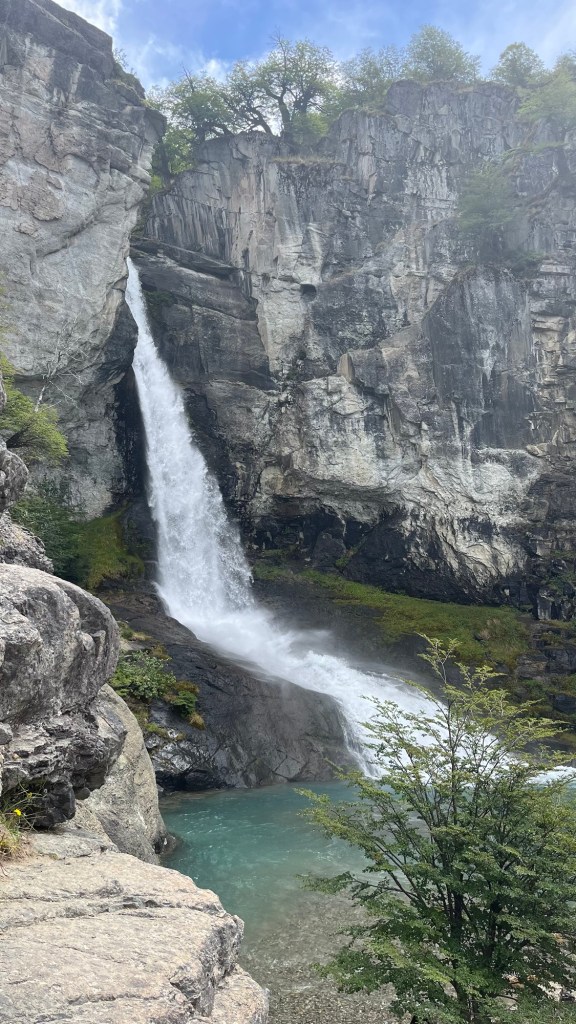
The weather wasn’t great the next few days, so I found myself in a bit of a holding pattern until Lucia’s arrival. Luis arrived on my second day, another welcome friendly face, so the two of us met for coffee in the morning and then walked the short, flat trek to Chorillo del Salto, a large waterfall just outside of town. We stopped for beers and empanadas and live music (in reality, the warm-up sessions for a gig later than night) in a bar at the edge of town. I had a nice dinner — steak again, when in Rome — with the English guys I had met in El Calafate, who taught me an Argentinian card game they’d brought with them. The next day I caught a bus to Lago del Desierto, an hour up-valley from El Chalten. A short hike of under an hour (however, almost straight up a cliff, clinging to ropes) brought me to the Huemul Glacier. I admired the turquoise water and watched the glacier from relatively close, trying to understand the marks of its retreat on the stone below. It started to hail, so I retreated for cover under a large rocky overhand with an Argentinian couple named Felipe and Angi. We chatted for awhile over sandwiches (me) and mate (them), and hiked down together to the lake shores, where I read my book and napped as they had a picnic. All in all, a decent use of a rest day. I passed out in the bus, waking up to find myself in the middle of Chalten again, with messages from Lucia to meet her at a rental shop.
After sorting the logistics for our tent rental, we got empanadas and then went our separate ways, planning to meet in the evening for drinks. I headed back to my hostel and was surprised to find Josh, a Scottish-American guy who had been in the bunkbed next to mine, standing in the middle of the room. “What happened to you??” I asked incredulously. Not only did he look like he’d been through hell, but he was supposed to be camping at Laguna Torre tonight. “I got to the campsite and it was snowing,” he said sadly, “so I figured, fuck that, and came back…I haven’t eaten anything all day.” While a shitty situation for Josh, it worked out well for Lucia and I, as I invited him to come camp with us the following night. “At least you’ll freeze in company, plus we can share the weight of our food…” This was a fair trade-off to him, so the two of us made our way back through town in search of a bar to meet Lucia. On the way, admiring the views of Fitz Roy (which had briefly emerged), I told him about Luigi and his stories of dreaming to climb Fitz Roy as a young Italian climber. And, lo and behold, there was Luigi, walking towards us with a friend of his. Like he had accidentally summoned me in Calafate, I had done the same. We said hello, made introductions, and then Josh and I continued to a bar playing music across from Lucia’s hostel. We had just sat down to beers when the English guys walked in, so I called them over and we all sat together for another card game and a few rounds of drinks.
The next morning, Josh, Lucia, and I met outside the rental shop at 9am sharp to pick up a tent for Lucia and I. We hit the grocery store for important final provisions (beer, chocolate) and then were off. At the edge of town we showed proof of payment to the rangers, who did not check to confirm that we had actually booked the campsite. Then it was a few hours of climbing, dodging day trippers and trying not to knock them off the trail with our large backpacks. We had views of clouds rolling in from up the valley where I’d been the day before, and we alternated between sweating in hot sun and shivering as winds blew in, threatening rain. We reached Laguna Capri around 2 hours in, and stopped on a sandy beach to take off our packs, and have a snack. It was a beautiful lake, surrounded by forest and with views of the mountains beyond — I would have loved to swim had it been a bit warmer. Hard to believe it is mid-summer here.
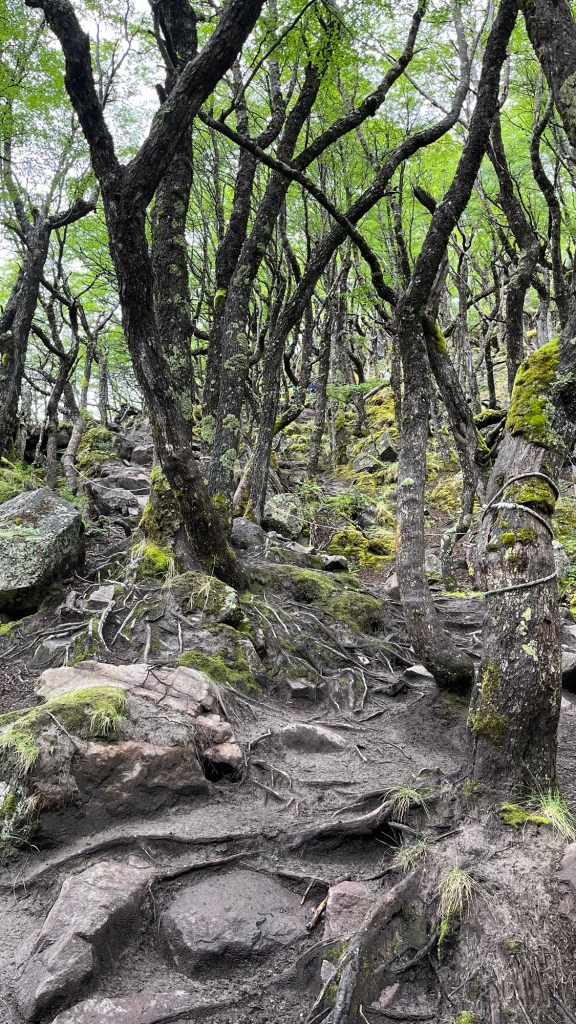
From Lake Capri it was a relatively easy walk to Poincenot, the campsite for Fitz Roy. We picked a spot at the edge of the campsite and Lucia and I got to work pitching our rental tent based on a confusing diagram we had been given in the rental shop. As it turns out, it takes 2 math degrees (well, 1.5 since Lucia’s is in progress) to correctly pitch a tent. Proud of ourselves, we sat around the camp stove with Josh and set up lunch: some dehydrated curry from him, bread and chocolate from us. The cold descended as we ate, and we sat shivering, looking into the endless clouds where the mountains should be, trying to figure out a plan for the afternoon. Ultimately, with my prodding, we decided to make the hour trek up to the Laguna de los Tres— the clouds were, theoretically, supposed to lighten up in the afternoon. Besides, we were here, what did we have to lose? So, we packed up day packs and started the climb, running into Luis on the way and promising to text when we were back in town. Lucia and I debated if this was better or worse than Torres del Paine — it was steeper in some parts, for sure, but knowing we were close to camp helped. Josh helpfully reminded us that there was a false summit near the top, as we scrambled up steep ledges of rock, trying to keep our footing, Lucia and I both moderately injured and out of breath.
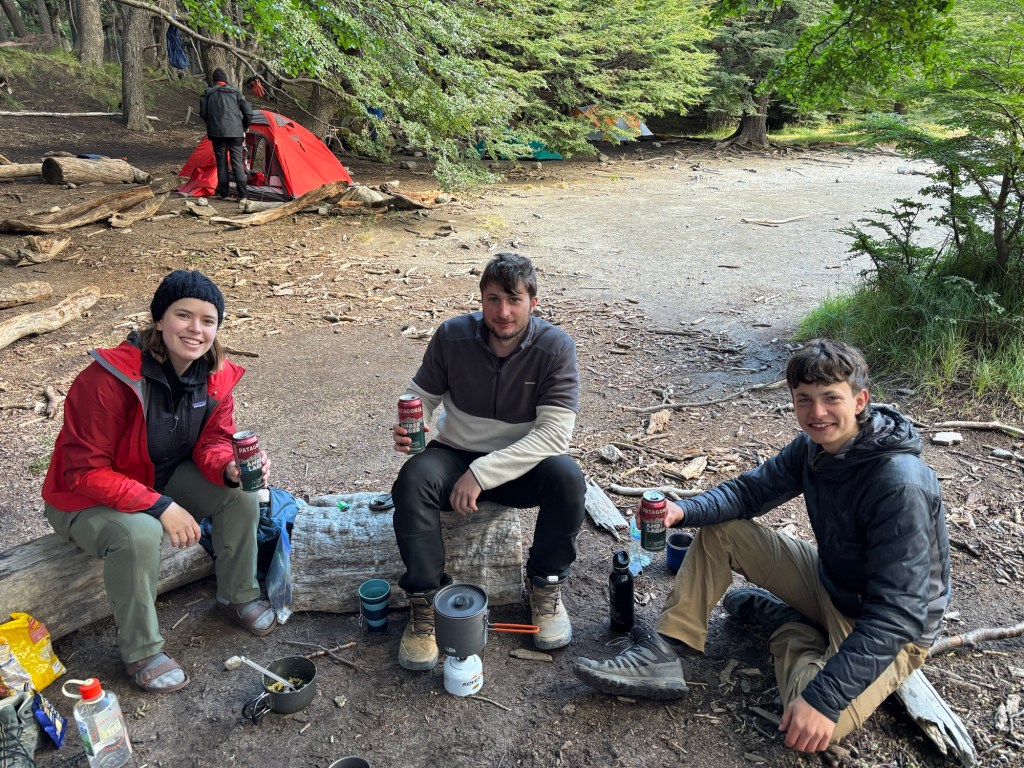
We finally reached the viewpoint to find that the clouds had not opened up. Even so, we could see the edges of the mountains through the wisps of clouds. I climbed up a rock over to the left of the viewpoint and found myself overlooking the deep turquoise and ironically named Laguna Sucia (dirty lake). The color of these glacial lakes never fails to impress me. I called up Lucia and Josh, and we were joined by Gaelen, an 18-year-old Canadian wildlife firefighter (and expert birder) who had pitched a tent near ours. Josh snapped photos on his film camera (a much more impressive one than my point-and-shoot), and we hung around for awhile waiting to see if the weather would change. Eventually it became clear this was not going to happen, and we were getting hungry, so the four of us made our way back down quickly to camp. We invited Gaelen to join us for beers while we made dinner: an entire 500g bag of pasta cooked in soup from a soup packet (a key learning from my TdP days), and some grated cheese. A backcountry cacio e pepe, if you will. It was probably terrible but in that moment was delicious, and the three of us scarfed it down straight from the pot while Gaelen ate his dehydrated bolognese and looked on, bemused.
After dinner, as I was headed to the nearby river to collect water, I saw the clouds were starting to clear. I called the others over and a small group of campers began to form, snapping photos of the till-then-elusive Fitz Roy as wisps of pink clouds swirled around its peak. Giddy, our group of four began discussing plans for the next day. My plan had always been to go for sunrise, but this surprise view had convinced the others to come along as well. So, we talked through a packing list and divvied up responsibilities, and agreed to set off at 4:30am. After one more “pot” of tea (consumed straight from the camp stove), we retired as the light finally faded, excited and anxious to wake back up in a few hours.
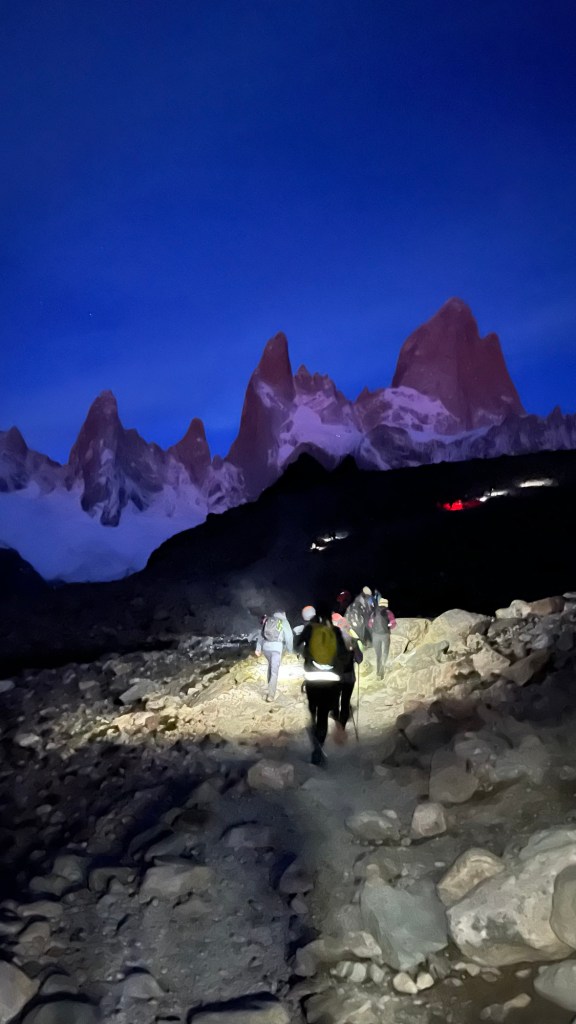
The night was…rough, to say the absolute least. I had severely underestimated how cold it would be — even after shivering at this same campsite earlier in the day. Sleeping in just a base layer, I woke up repeatedly to add more and more layers, pull my hat over my ears, my buff over the rest of my face. Lucia, too, tossed and turned and struggled to get warm. At one point we slept back-to-back in our respective sleeping bags for warmth. When my alarm went off at 4am, it was met with curses and groans from both of us as we pulled on the few remaining layers and began to prepare to leave. All was forgotten, however, when I stumbled out of the tent, past the edge of the forested campsite, and caught a glimpse of the stars. It was incredible: I could see the white stripe of the Milky Way and more stars than I had ever seen before, even in Nepal. Being in the southern hemisphere I struggled to recognize any of the constellations, but even so was starting with my neck craned when Gaelen came to join me. As we finished our preparations we looked around — most people in the campsite had the same idea, naturally, and we were surrounded by bobbing red and white headlamps. And, looking in the direction of the trail, we were shocked to see what looked like a trail of twinkling stars in the mountains — only to realize it was a line of scores of hikers, already climbing up towards the viewpoints. Jesus, they must have started early — some people even go from town at 1am.
This was enough incentive to get a move on, so the four of us, headlamps on, set off from camp. Ahead of us, the inky black silhouette of the mountains began to form against the deep purple of the night sky. I took Gaelen’s advice to “be bold, start cold” (he seemed to have the most wilderness experience of all of us, so I was very glad to have him), and had stripped back down to my base layer and windbreaker. It was good advice, as we loped past a few slower walkers, I was quickly breaking a sweat even in the near-freezing temperatures. Eventually I sent Josh and Gaelen ahead — I couldn’t keep up with their pace — and Lucia dropped back behind me. None of us was alone, of course, as we were surrounded my hikers making their way up. I sang quietly to myself, tried to not think about my knee (which was unhappy to be making this same ascent again in under 12 hours), and tried to calculate what percentage of the way up I was already. Towards the top, I reached a section of rocky ledges I recognized from yesterday, however today they were slick and wet, and I struggled to find good footing in the dark. I tried to go slowly and be careful with where I stepped, but even so at one corner I felt my feet come out from under me and slammed down hard on my left side. Two French hikers stopped to check on me — after a quick assessment I confirmed that I was fine, minus a gash on my hand which I cleaned with water for the time being. A bit frightened now of falling again, especially on some steep sections ahead, I moved even slower and more carefully. The one good thing about hiking in the dark, I reminded myself as I navigated one particularly tricky section, was at least you don’t get vertigo — you can’t see how steep the drop-offs are. Despite my caution, I was eager to get to the top before daybreak, and once I got to the “false summit” took the last, flat, rocky section at almost a jog. Cresting the final hill, I heard Josh and Gaelen calling me from a nearby rock, where I collapsed in exhaustion to wait for Lucia and patch up my hand (Gaelen brought a first aid kit — like I said, a good addition to the group).
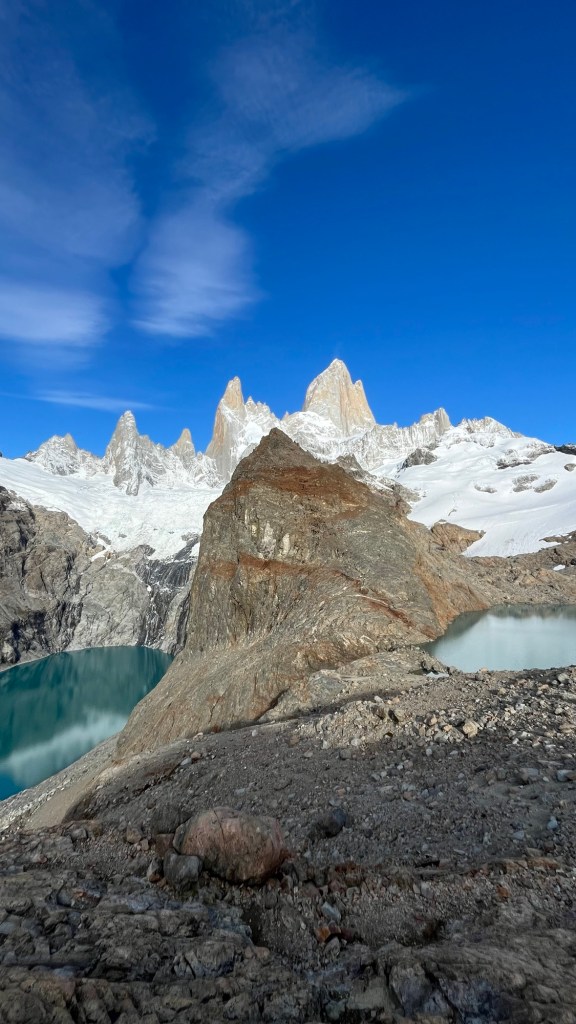
By now the sky was a deep blue, and behind us a strip of orange had appeared on the horizon. The white of the glaciers seemed to almost glow in the dawn. Based on my photos from my first day, I estimated that we had until about 6:35 until the light hit the mountains. So, we set up our “camp,” a joint effort: I laid out my ground cloth (thanks, VF over-preparation), the four of us unrolled our sleeping bags, Josh took out his stove, and we all contributed food and drinks. As we recovered from the climb it had gotten cold, quickly, and all four of us ended up kicking off our boots and fully climbing into our sleeping bags. We set up time-lapses and took photos. Slowly, a line of brilliant pink began to creep down the face of the mountain. Sure enough, at 6:37 the entire mountain glowed orange as if lit from within. I couldn’t wipe the smile from my face — it was an incredible experience. I took a few photos, then lay back in my sleeping bag and tried to soak it all in. I’ve tried my best but all I’ll say is that words can’t really describe the emotions of the moment. I was struck by how lucky I was to be here, now, experiencing this perfect, cloudless sunrise. How grateful to live on this beautiful planet, and to still have preserved pockets of the world without human interference.
As the red glow faded and the lakes began to turn blue, we fired up the camp stove and made breakfast, courtesy of Gaelen: 8 servings of dehydrated paella, plus two eggs mixed in. We passed the pot and a spoon around. I looked down at the mussels in the paella, up at the mountains — an improbable combo — and proceeded to completely scald my mouth to the point of not really being able to taste. Oops. After breakfast, Gaelen had to head down to hike back to town with his father. We thanked him for everything and wished him well — we’d make a group chat to share photos when back in cell service. Then Josh, Lucia, and I packed up the sleeping bags (which had allowed us to outlast almost all the other sunrise hikers and have a few moments of solace) and headed back to the overlook abice Lake Sucia. It was a place transformed from yesterday, with a blue sky and clear views of the peaks. We stayed for a long time, taking photos and procrastinating, but eventually it was time to say goodbye. With longing final looks, we headed back to camp, passing a long line of day-hikers who had made their way up in the early morning to avoid the rangers.
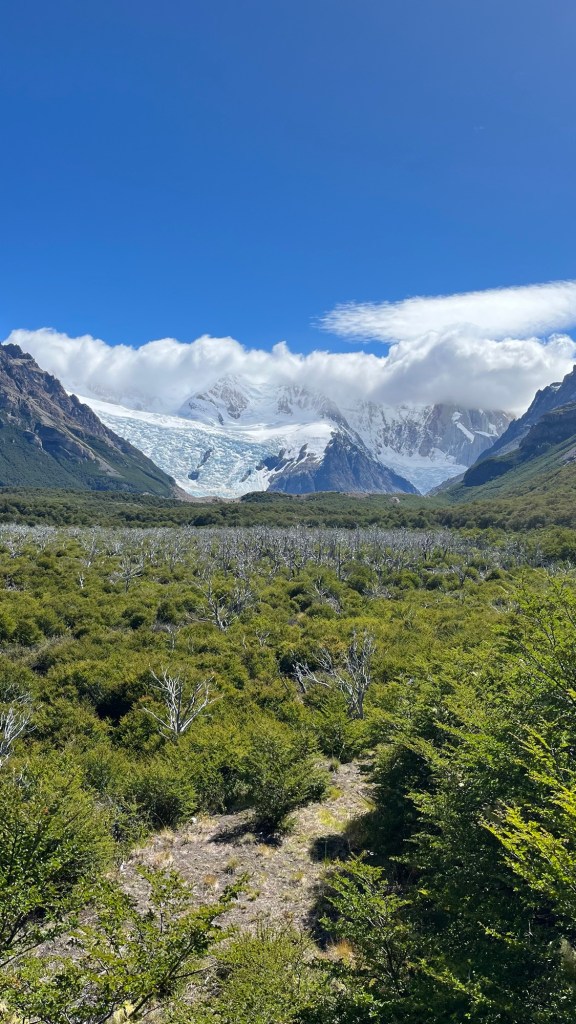
At camp, Lucia and I took down the tent — one of the pegs had inexplicably disappeared in the middle of the night, to our confusion — and packed up the rest of our things. From here we would split up: Josh to check out a nearby glacier, Lucia back to down to take care of her injured knee, me…to add another 20km to the day and see Laguna Torre. [Insert Charles Leclerc “I am stupid” meme here]. Lucia was taking the tent down (I had carried it up) so at least my pack felt lighter than expected. I promised to see them in town for a celebratory dinner and set off, smiling in the now late-morning sun as I ambled alongside a river, Fitz Roy still visible to my right over a grassy field. I headed out along the Laguna Madre e Hija trail, listening to music and enjoying that the walk was basically flat. To my left, the two lakes (warmer, so not that glacier blue) rippled in the breeze and reflected the mountains and glaciers beyond. Past the lakes I walked through fields and a forest, passing only a few hikers — including one who asked to see my photos from the sunrise this morning, and showed me the photos he took of Fitz Roy from town. As I started along a downhill forested section I could feel my knees starting to give out. But it was too late now to turn back so I trudged onward. Eventually the trees opened up to a fantastic view up valley to two massive glaciers perched high on snow covered mountains, over a green sea of trees. I stopped for a break to enjoy the view before making the final push to Laguna Torre.
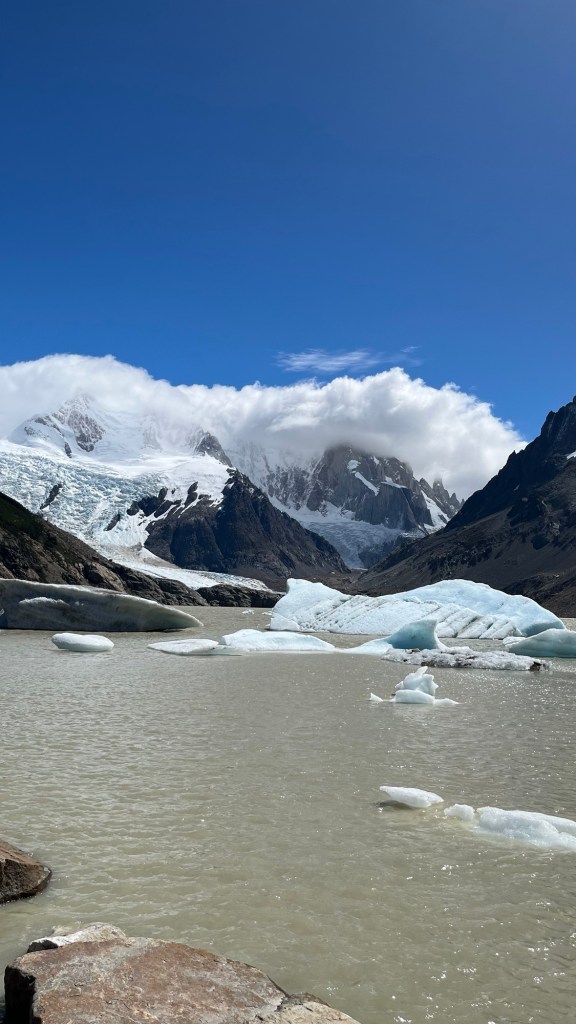
After the unbelievable views at Fitz Roy this morning, to be completely honest Laguna Torre felt like a bit of a letdown. Maybe this was the exhaustion, the pain, or the fact that I couldn’t be bothered to walk back uphill to a slightly more scenic viewpoint. But I arrived in gale-force winds to a soupy grey lake with massive dirt covered icebergs floating by, and the glacier view obscured by rocks. I could barely stand at this point so retreated to a small wind shelter made by previous hikers, grabbed some glacial ice floating near the beach, and laid down in the sun to ice my knee, make lunch, and take a much-deserved nap. By the time I awoke it was already 2:30, meaning I’d been up and moving for 10 hours already. It was time to get back to town. So I bid the lake farewell and headed back to the path.
The path traced a rocky, barren riverbed under the hot sun. Signs warned of flash floods for a reason I hadn’t considered — as larger chunks of ice come off the glacier, they displace more water in the lake. This can cause the lake to unexpectedly break its banks, spilling large volumes of water into the river. I noted this with interest as I pushed onward. All trail marking has disappeared as I wound my way between low, scrubby, bushes, but I figured if I just kept heading generally forward it would sort itself out (which it did). I made it up a short climb to one last mirador with a view of the glaciers — goodbye, glaciers, my last of the trip — and gritted my teeth to push through the final hour of descent into town at barely a limp. Putting any weight on my right leg sent pain shooting up the outer edge of my knee. Clutching a rope and almost rock-climbing down steep sections, I had no option but to just try and ignore the pain and get back to town. Finally I could see El Chalten — but to my horror realized I was still about 100m above the tin roofs below. The last section into town involved me literally sliding down a dusty, pebbly trail on my heels, just trying not to break anything, cursing in multiple languages on my way.
Finally, thankfully, I made it back to my hostel where I dropped my pack and collapsed on the floor in relief. I was only there for a few minutes before Josh arrived and did the same. The cool tile under my back and my legs propped up on my bed, I related my afternoon and Josh told me about the glacier he had visited (the photos looked amazing, and I regretted not having time to go see that as well. For next time.) Finally, I managed to motivate myself off the floor and into the shower, and then dropped off every article of hiking clothing I had to get washed. This was not the smartest idea as it meant I had to wear a dress for the rest of the day — both unfashionable in trekker capital El Chalten, and impracticable as temperatures and dropped and the wind had picked up. Josh, Lucia, Luis, and I met at a steakhouse for dinner, where I deleted an ojo de bife in truly record time. In one of the brief pauses between shoveling beef from my plate to my mouth, I turned to Lucia: “wait, aren’t you vegan???” Mouth full of steak, she responded “not today!” We split a bottle of Patagonian Pinot Noir that was delicious — no tasting notes, though, since my tastebuds had not recovered from being charred this morning by the paella. A perfect celebration to what had been a pretty much picture-perfect day — better than I could have even imagined.
My last day in El Chalten was spent in La Chocolateria, a Swiss-style cabin near the hostel, drinking hot chocolate with Lucia, Luis, and Josh and talking about life. Josh left at midday to catch his bus, and we sent him off with promises to come visit Scotland for some more frigid camping. Luis then peeled off, with more hugs and farewells. Finally, Lucia walked me to the bus station (stopping for one last jamon y queso empanada at La Roti, my favorite). We said our final goodbye there — I wished her good luck in the rest of her travels (and a safe time in Rio for Carnevale with Lukas) and we agreed to meet up in Europe when she is back in Denmark. Finally, with clouds moving in, I boarded my bus back to El Calafate, back across three hours of empty desert, ready to catch a flight to Mendoza.
This was the end of my Patagonian sojourn, one that started when I boarded the ferry in Puerto Montt just under 3 weeks ago. Yet it felt like so much more time than that had passed. I’d steamed across wide open waters, spotting whales and dolphins; hiked well over 100 miles across Chile and Argentina; visited glaciers, crossed rivers, and climbed mountains. I’d witnessed sunrises that will stay with me for the rest of my life, survived nights in tents with heavy winds and freezing temperatures, and learned more than I ever expected to about the birds of Patagonia. I made friends, met lovely people, and was surprised to find myself constantly running into familiar faces as I criss-crossed the region, on hiking trails, in hostels, and even in the street. This experience has inspired in me a deeper love of the outdoors, motivation to buy a tent after I move, and an important reminder of the need for conservation. Posting this blog now, with the US’s national parks more at risk now than ever in my lifetime, I find it more important than ever to preserve the remaining bits of wilderness we have left. This isn’t however, the end of my time in the Andes — more to come on that soon…ish.










 Eva on the Via Francigena (and beyond)
Leave a comment