Song of the week: Doors – Noah Kahan
Dirtbag [ˈdəːtbaɡ]: a climber who dedicates their life to the pursuit of climbing at the expense of traditional markers of success such as career, a roof over one’s head, or regular showers. Can be seen living out of their cars or sleeping rough near popular crags, dumpster diving for food, etc.
I am not a dirtbag and never will be, to my own chagrin — though to friends and colleagues who know me in my “normal” life, I’m sure how I choose to spend my free time and dress myself does make me seem like one. But I do have a fondness for the ingenuity of the dirtbag, whether the stories of Yvon Chouinard eating tinned cat food while sleeping rough in Yosemite (okay actually, yuck) or the kid I met in Cham last October who sold his car to buy cams. So, I’m contributing to the literature through some on-the-ground reporting from the French Alps. Hope you enjoy!
Swiss law requires that employees take two consecutive weeks of holiday, inconceivable to Americans who typically get 2-3 weeks total for the year. They can make me take off work (not that that takes too much convincing), but they cannot force me to relax! I chose to use my PTO on 2 weeks in Chamonix, the historic heart of European alpinism, where you can be whisked by lift up to 3800 meters, descend a steep and exposed arete via an ice cave and then re-emerge a few hours later on one of the viewing platforms having climbed a red granite face or a chossy ridge. Or zip up a few pitches in the Aiguilles Rouge before lunch, with the expansive vista or the Mont Blanc massif in your peripheral the whole way. It’s one of the few towns in Europe a casual tourist can wander through, looking for a cafe with a nice terrace, and have to pick their way between lanky trail runners with their vest packs and shiny sunglasses, alpinists laden with ropes and ice axes, and hikers hauling their camping gear in impossible large packs.
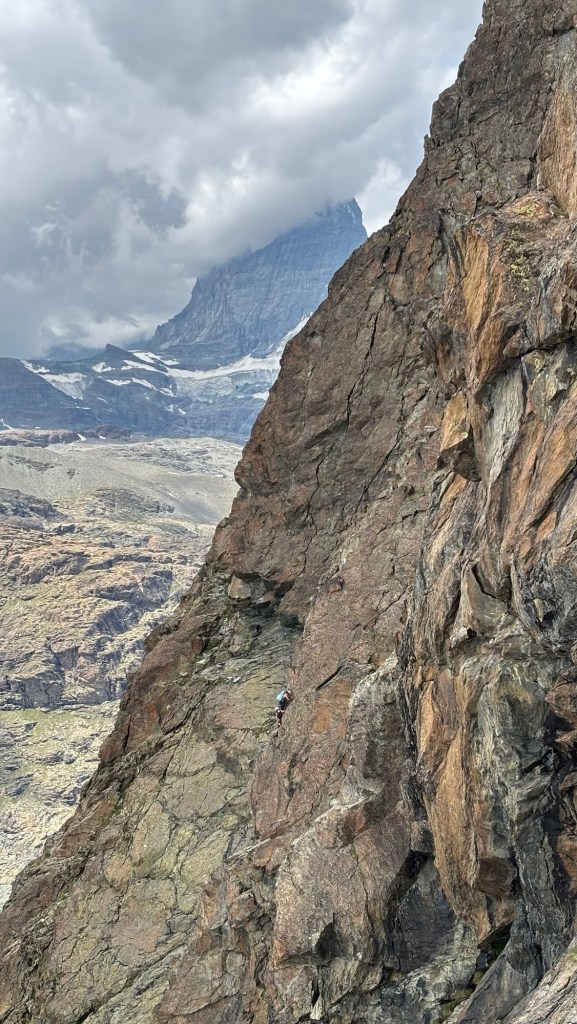
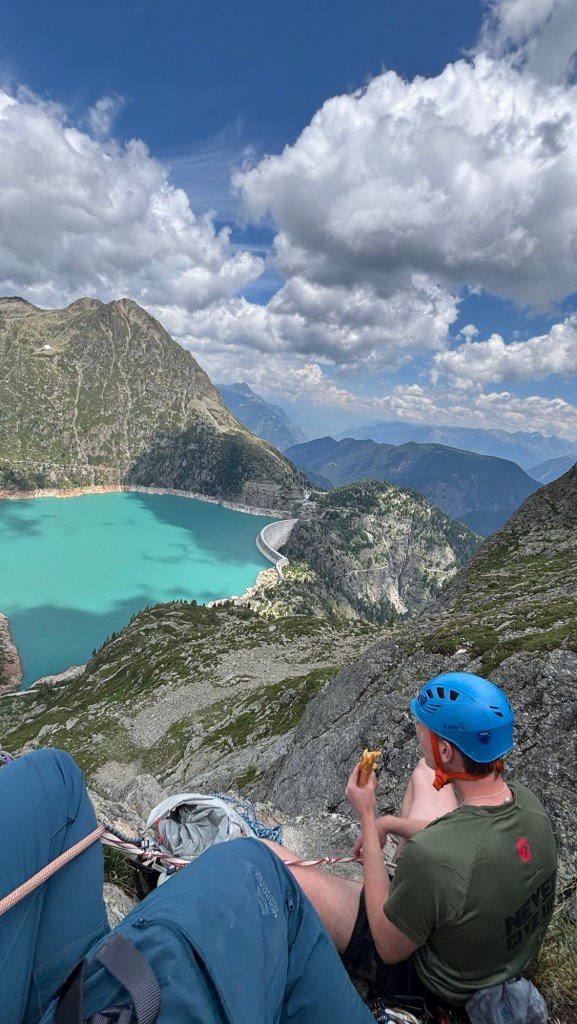
I started my holiday hitching a ride to Chamonix with my friend Scott, who I met on an app called Oak used for finding climbing partners. A few weeks back we climbed the Clocher-Clochetons traverse together and narrowly avoided an “epic” (climber jargon for “the worst day of your life — so far”) despite getting horrendously lost on both approach and descent, bushwhacking our way across steep slopes and stumbling down boulder fields. Not to mention the climbing which involved me getting stuck briefly in an off-width crack, us getting slightly lost on an abseil (hard to do!), and my building of a Tyrolean traverse for us to drag ourselves hand-over-hand across a chasm. We came out of the experience as friends and climbing partners, and he had come to Switzerland for the weekend for a bit of multipitching (much like Mark Twain, we climbed the Riffelhorn) and to chill by the lake. He and I had another big day climbing “Acqua Concert” in the Aiguille du Van above the Emosson dam on the Swiss / French border — 12 pitches (max 6a), 400m of ascent above the sparkling blue glacial water of Emosson Lake. Per usual, we picked the wrong route on the descent and instead of an “exposed but easy path” found ourselves abseiling down a 35m high cliff. The last ones on the wall due to our late start, we stumbled down a steep scree field back to the car by 7pm, and rolled into Chamonix with windows down and screaming the lyrics to Noah Kahan’s “Doors” just in time for dinner. At this point we were joined by my friend Theresa (German Theresa, not Harvard Theresa) for hot dogs and beer in the city center.
Following these refreshments I checked into the UCPA dormitories into the center of town. The UCPA is a French organization meant to provide affordable access to mountain sports for young people, and I’ve climbed with them twice now in the Gorges du Verdon and the Calanques. Theresa and I had signed up for an intermediate alpinism course and would spend the next week learning how to become autonomous (i.e., climb without a guide) on alpine ridge routes. However, the course didn’t start for another day as we had opted to arrive a day early — so with no need for an early wakeup, Theresa and I ventured back out to check out Chamonix’s nightlife. After one demi-blonde (small beer) each, we found ourselves on the small dancefloor of a bar alongside a flamboyant group of French 50- and 60-somethings who made up line dances to each successive disco song that came on. Suddenly, the vibe of the music changed and the French all got on the floor and began doing what I thought was the Norwegian world cup row — until people began lining up and crowd surfing over the line of people! One of our new friends beckoned me towards the front and a few moments later I found myself shouting “film this” to Theresa as I leaped into the arms of strangers, shrieking as I was carried to the back of the bar. The craziest part of all of this? The same thing happened again the following night at the UCPA! Despite having spent a good deal of time in France I had never heard of this “tradition” and haven’t been able to find anything about it — if anyone has any information on it I would be keen to learn more.
Theresa and I took a rest day the following day, venturing up to the Aiguille du Midi complex at 3800m for a view, primarily, of clouds. We watched two climbers prepare to abseil off the top of the Midi South Face back to the viewing platform and chatted with a local guide about conditions. I told him I wanted to climb the South Face. He asked if I climbed and I replied “yes, a bit.” He suggested that “a bit” was probably not enough, to which I shrugged — he was probably right. After a very mediocre croque monsieur we caught the lift back down to town in time for a nap and then dinner and the kickoff of the UCPA program. Despite both signing up for the “evolution” (intermediate) level, we ended up in different guided groups due to our different experience levels. Theresa is much fitter than I am, but has spent less time climbing so is unfamiliar with belaying and some of the other ropework — we agreed to be split up in order to both make the most of the course. Plus, not being together all day meant we had plenty to discuss each night over dinner!
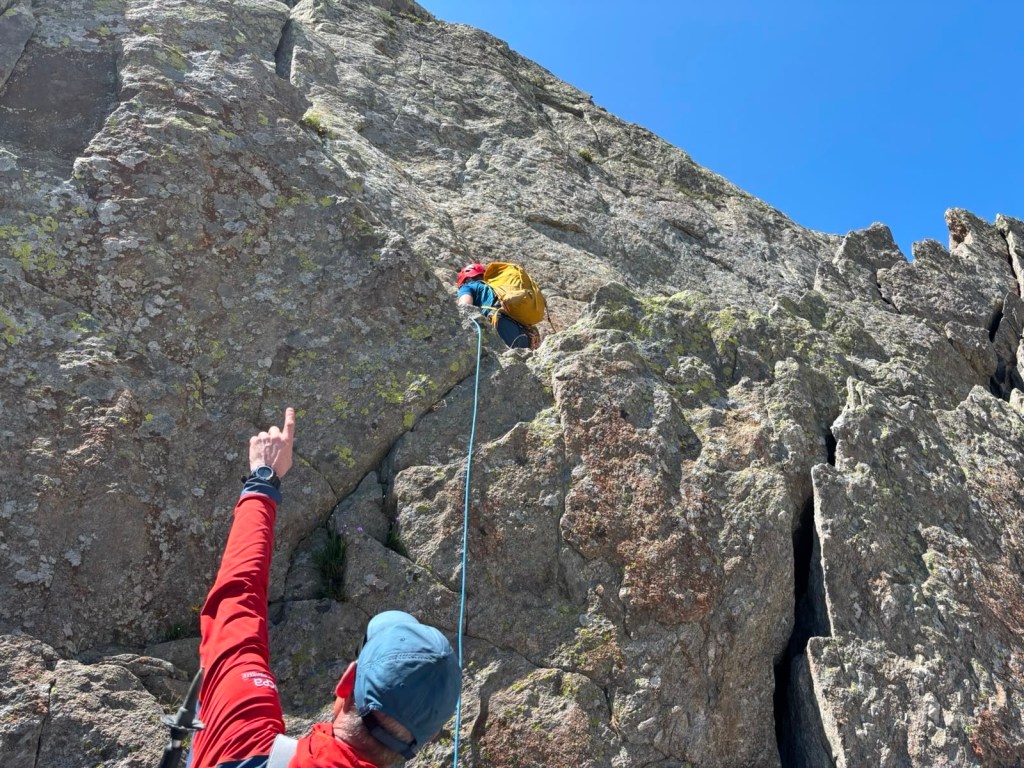
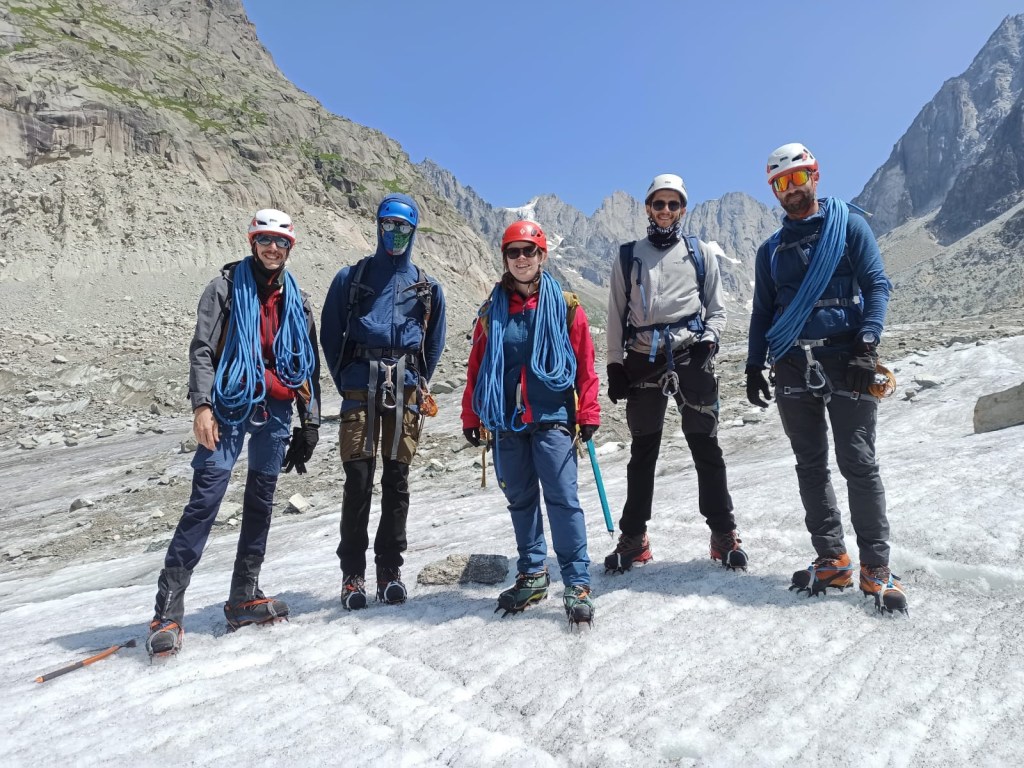
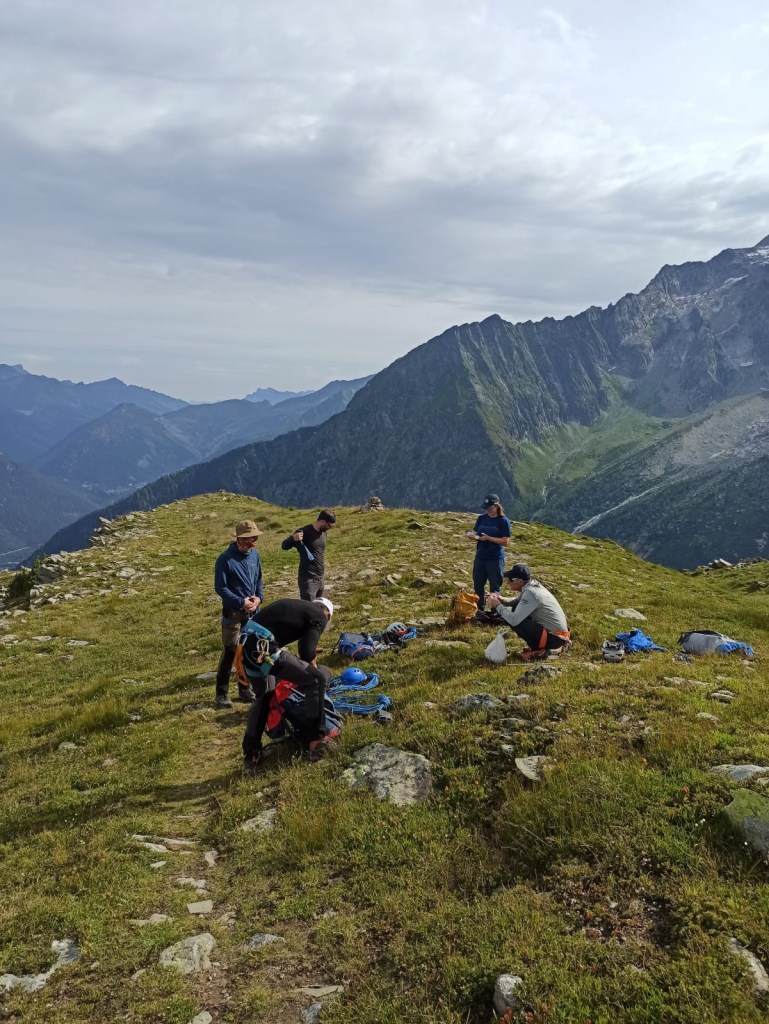
Over the span of 5 days the course covered rock and ice techniques, culminating in a hut stay and final tours conducted under the supervision of a guide. My group was 4 tall Frenchmen: Christophe, Nicolas, Clement, and Guillaume plus our guide, Eric. Because of the group makeup I was at a slight disadvantage, as everything happened in French — I could follow the instructions just fine, but would get lost during casual conversation during breaks and meals. Also, I realized quickly that my height was creating more work for me, as I jogged to keep up with the group on steep trails and found myself leaping between boulders that the others stepped over as we scrambled up the mountainside. Our first two days were “rock days” on the Brevent in the Aiguilles Rouge, covering “corde tendu” or tight-rope technique where you climb easy ground wearing coils with short lengths of rope between the two climbers, winding the rope around rock features like spikes to protect the climb and belay up the second. The second day we got an introduction to trad climbing. Most of the climbing I do is sport climbing on routes that have pre-placed bolts. Trad climbing, instead, you have to place your own protection — usually nuts (small metal wedges connected to a wire), cams or friends (blocking devices inserted into cracks) and slings (loops of nylon that can be looped around spikes or boulders). I’ve been keen to try but it is difficult to find ways to learn, so was very excited to get some practice climbing short sections of rock with Eric assessing my gear placements along the way.
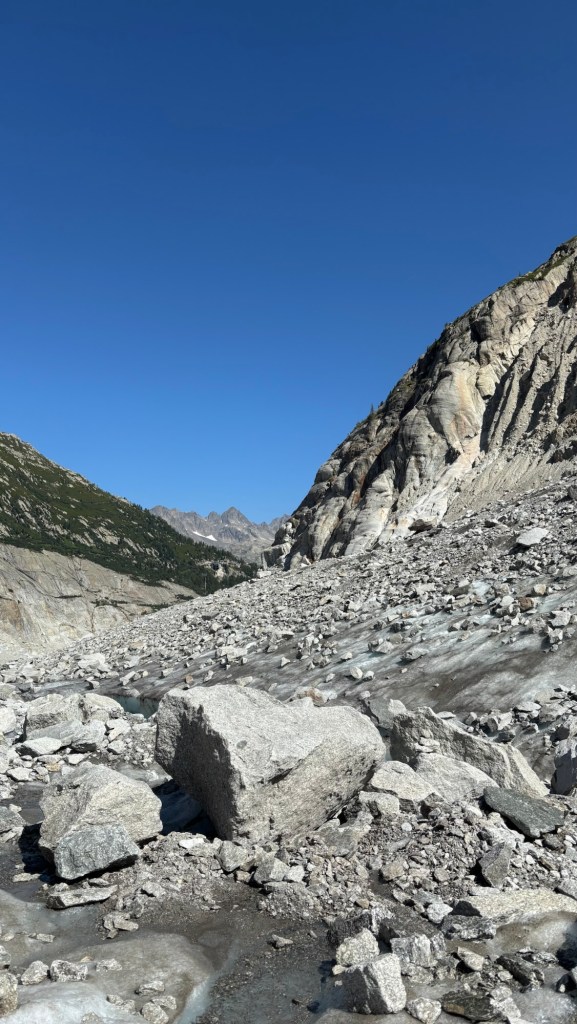
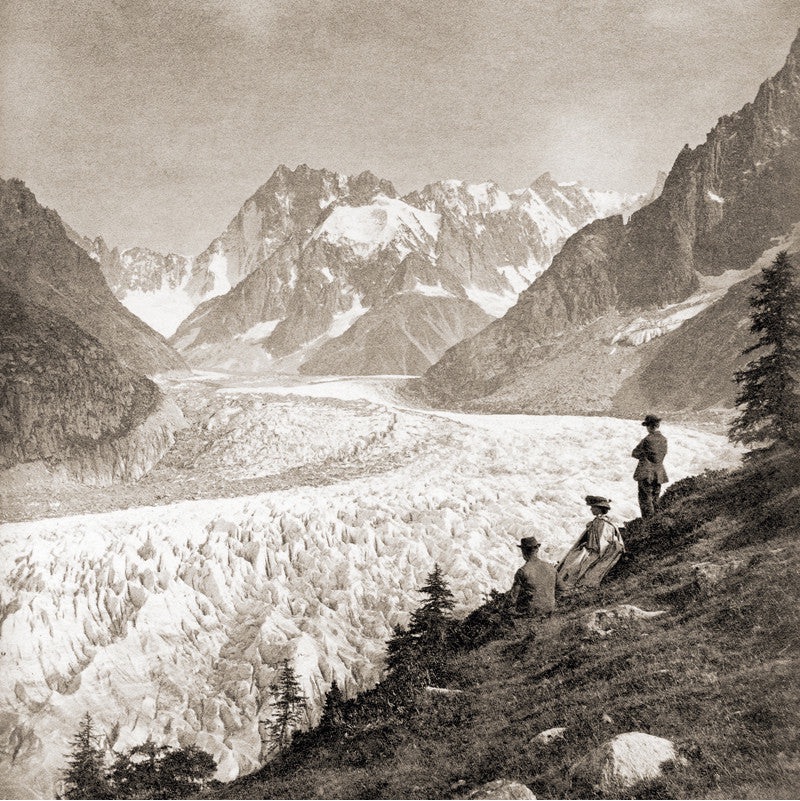
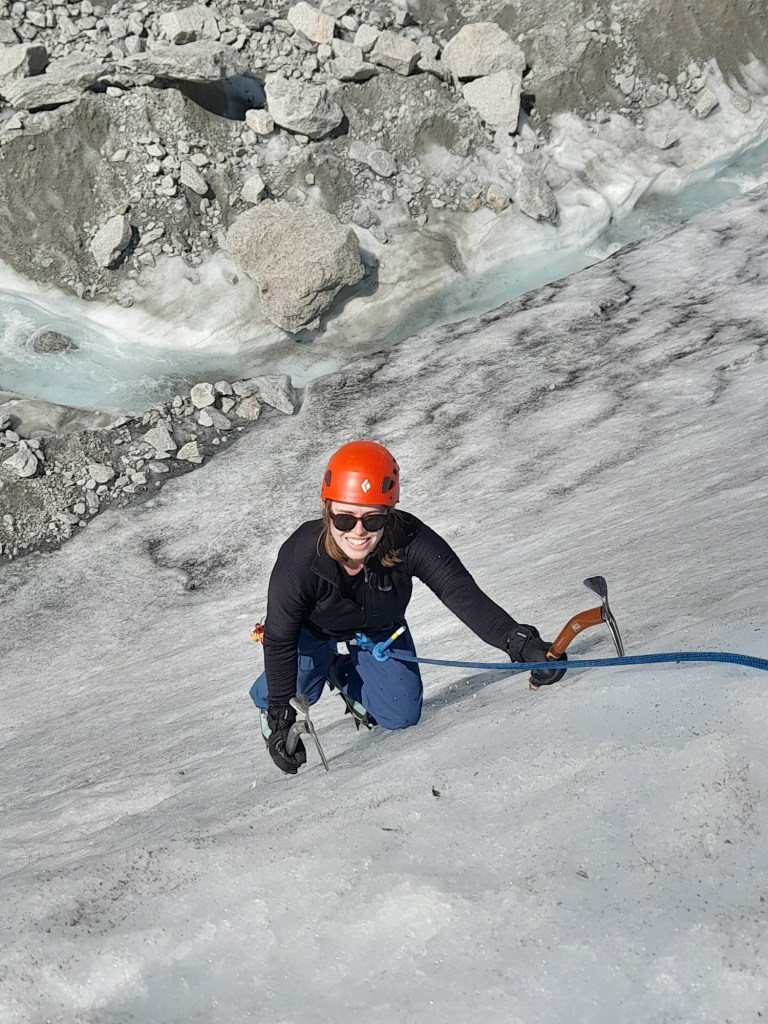
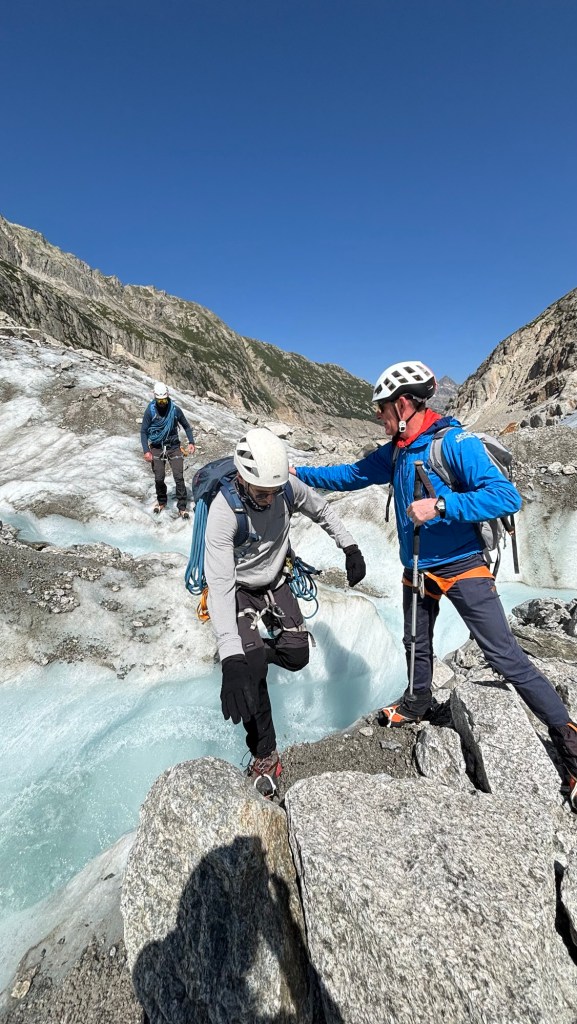
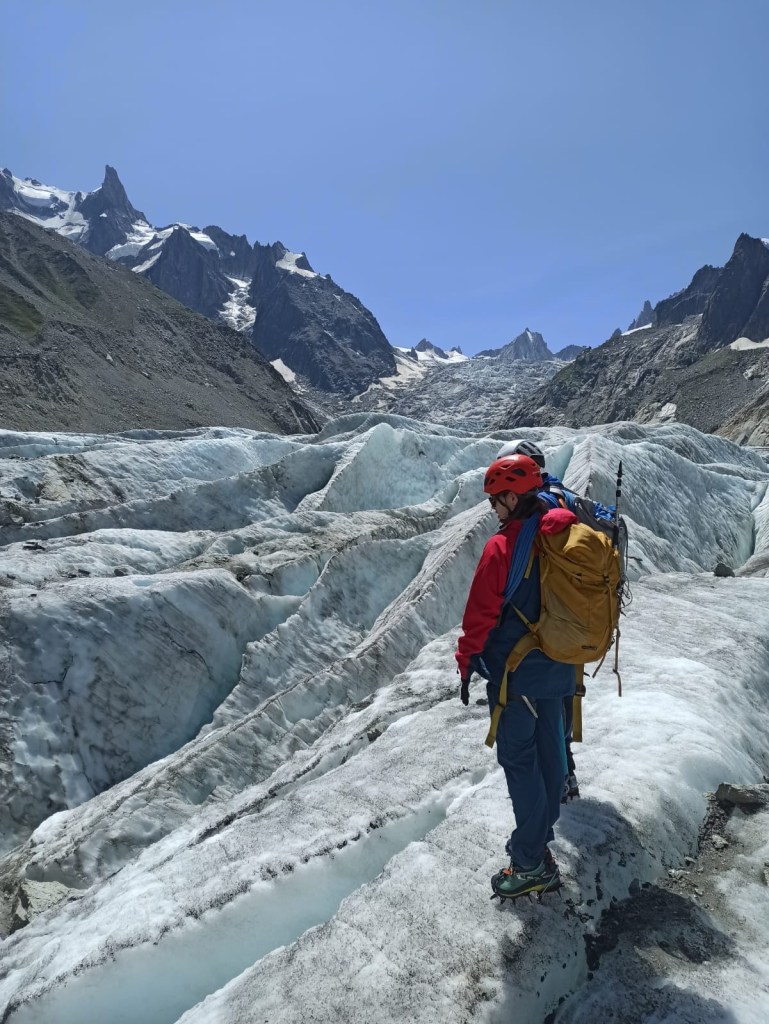
The third day was our “ecole de glace” (ice school) on the Mer de Glace, France’s largest glacier. This is one of the most depressing places in the Alps due to the retreat of the glacier, which used to hang imposingly over the town and which helped cement Chamonix as a stop along the Grand Tour. Signs along the glacier show its previous levels — 1990 is along the gondola ride down from the Montenvers train station. 2018 is at the bottom of the gondola but at the top of a set of metal stairs. To reach the ice in 2026, you have to descend the stairs, hop a gate warning of high alpine hazards, and walk another 30 minutes before actually touching bare ice. Our group made our way over loose rocks perched precariously in sandy glacial silt, eventually reaching the ice and pausing to put on crampons. Eric then took us through a series of cramponage drills — walking with French technique (cross stepping) up steep slopes, and planting our crampons firmly with each step as we marched down increasingly steep slopes. “Ok, here try to jump,” he showed ups, making hops down a steep icy slope. I was petrified — I don’t really like being in crampons — and on my second hop managed to hook the front point of my crampon and topple forward. I watched in horror as Eric jumped into my fall line to stop me from hitting the rocks below, but managed to get my feet back under me and keep myself from actually falling. Now even more scared, I did my last few jumps to rejoin the group, who congratulated me for being quick on my feet. Then we moved on to building anchors with ice screws on the top of a tall wall of ice with rushing water below. We then lowered each other down the wall and climbed back up, using two axes and the front points of our crampons to propel back up the near-vertical ice. While I’m quite comfortable on rock, I struggled on ice, not really trusting my crampons and having to kick in multiple times before standing up. After a few laps of climbing we continued walking up the glacier for another 40 minutes, leaving the relatively flat and crevasse free section and arriving to a steeper, wavier area that gives a better sense as to how the “Sea of Ice” got its name. Here we practiced short-roping techniques as we hopped over crevasses, climbed narrow ice ridges, and navigated the waves of ice. Eric showed us how to build a 3-to-1 pulley system for crevasse rescue (the group wanted to send me into the crevasse as the lightest member: thankfully Eric sent our packs down instead). I took some time to snap photos of the Tour Rouge and Aiguille de la Republique, which Scott and I had discussed climbing, and then we headed back to the steep walls for a bit more ice climbing and then our descent back to Montenvers.
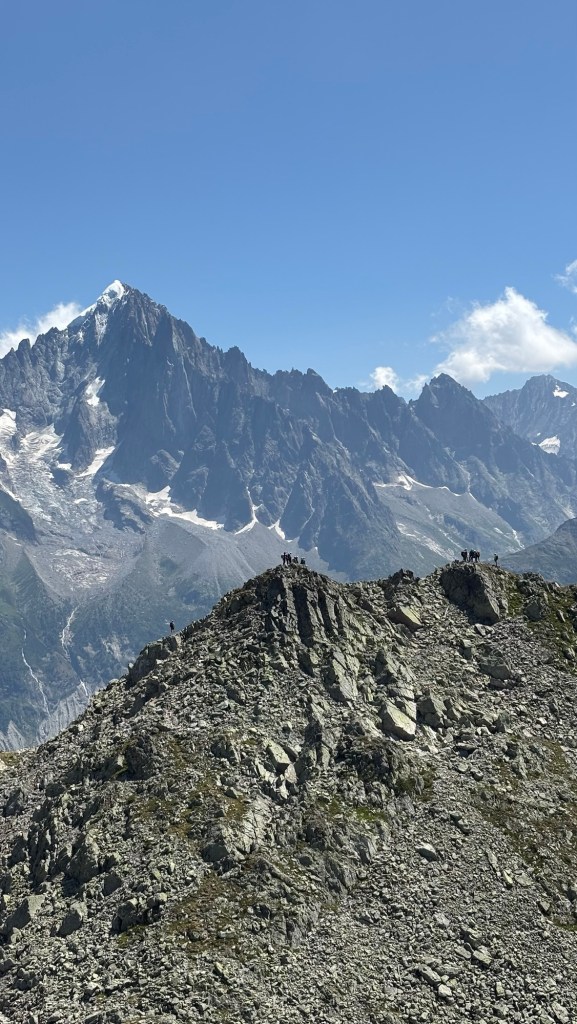
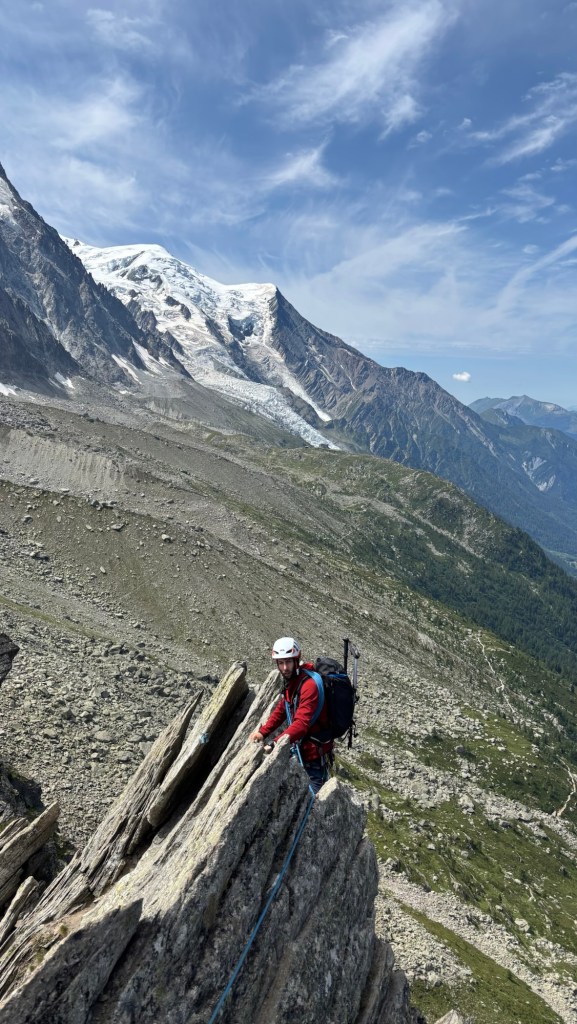
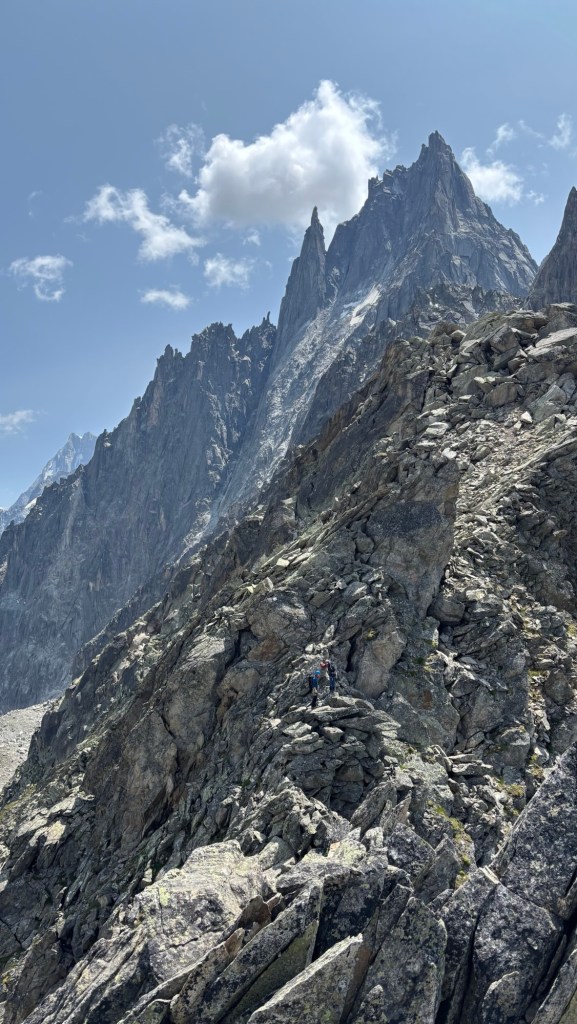
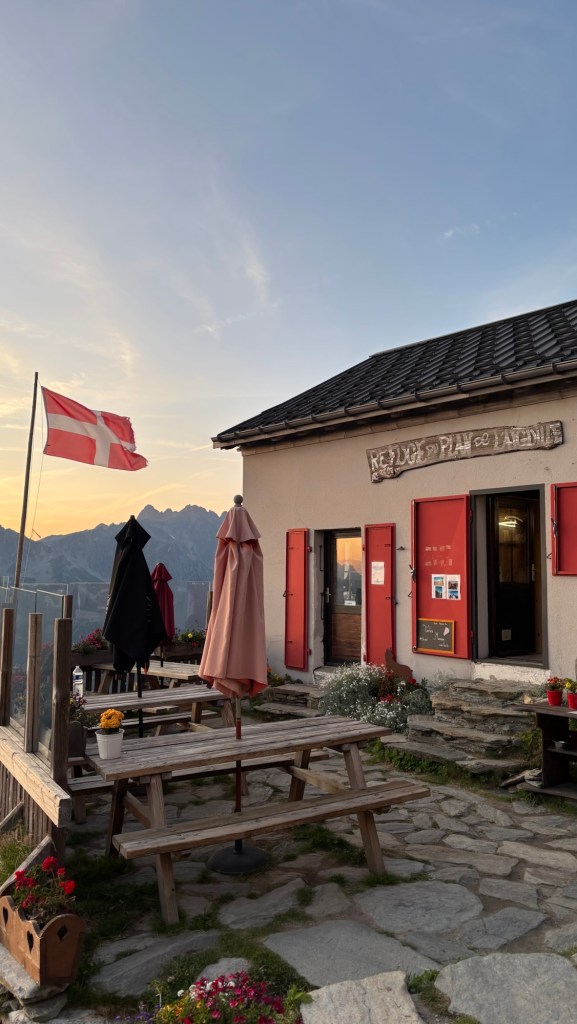
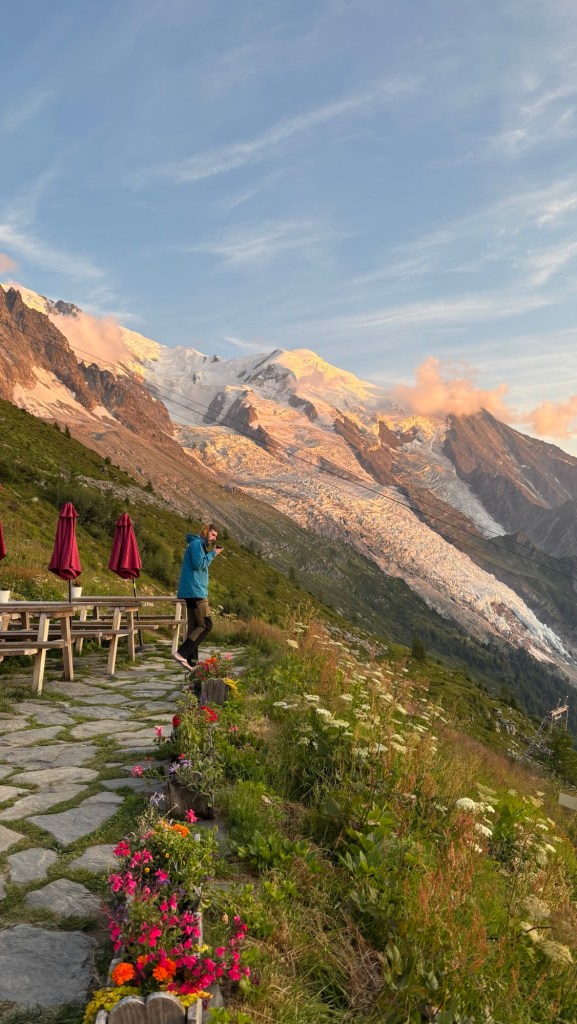
The fourth and fifth days of the UCPA course are dedicated to high-mountain tours and refuge stays. So, the morning of Day 4 we were back on the first Montenvers train up out of town. This time, instead of descending to the Mer de Glace, we hooked a right and started hiking up the Grand Balcon Nord trail up to Le Signal. After about an hour of hiking we reached the foot of the Fretes des Charmoz ridge, where another guided group course seemed to be making slow progress. Eric suggested we stop and have a (very early) lunch while we wait. The sun was unbearably hot (as it had been all week), but I was glad to have a bit of wind to cut the heat as I gnawed on my ham and cheese sandwich. The ridge itself was a long but relatively easy climb. I was leading Eric as the other boys were paired off with each other. Nicolas and Cristophe quickly built up a huge lead on us, while Eric hung back to advice Guillaume and Clement, so I didn’t have a good sense of what our (my) effective pace was. The route was a mix of scrambling with some interesting easy climbing sections interspersed, requiring the one-off cam placement and proper belay. Over the course of the day I tried to work on doing longer pitches rather than immediately belaying Eric off of the first option I found, thereby letting us move a bit more efficiently. The groups eventually rejoined for a short section of narrow, knife-edge ridge which required a few delicate steps (especially for me, as I could barely reach one of the footholds as I came up and over the other side). Ultimately, we covered the ridge in about 5 hours and then stumbled our way down the steep scree field below Aiguille de l’M back to the trail and to the Refuge du Plan de l’Aiguille, where we would spend the night. We dug into large slices of tarte aux pommes, watched the sunset turn Mont Blanc pink, and got a shockingly good night’s sleep.
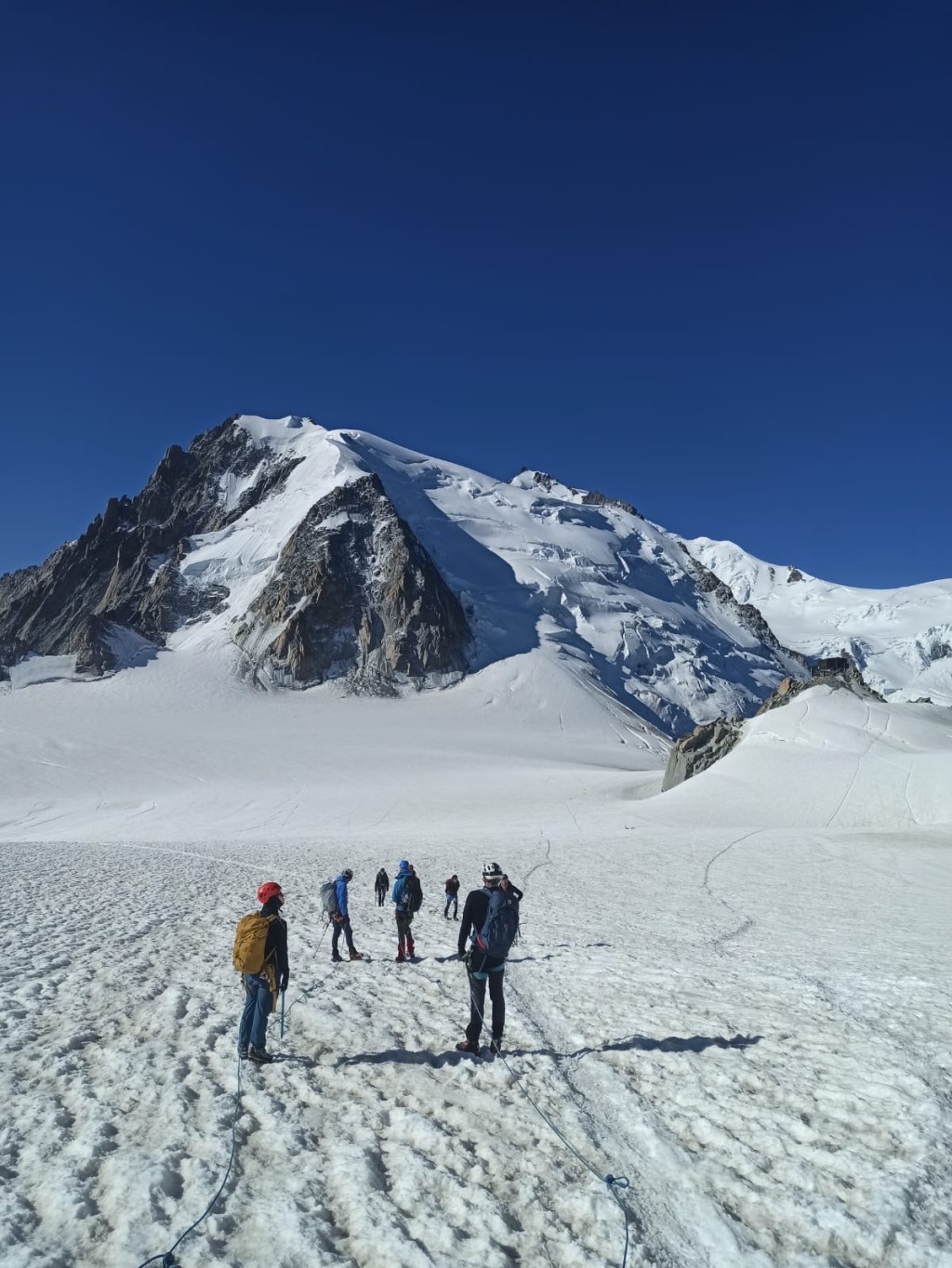
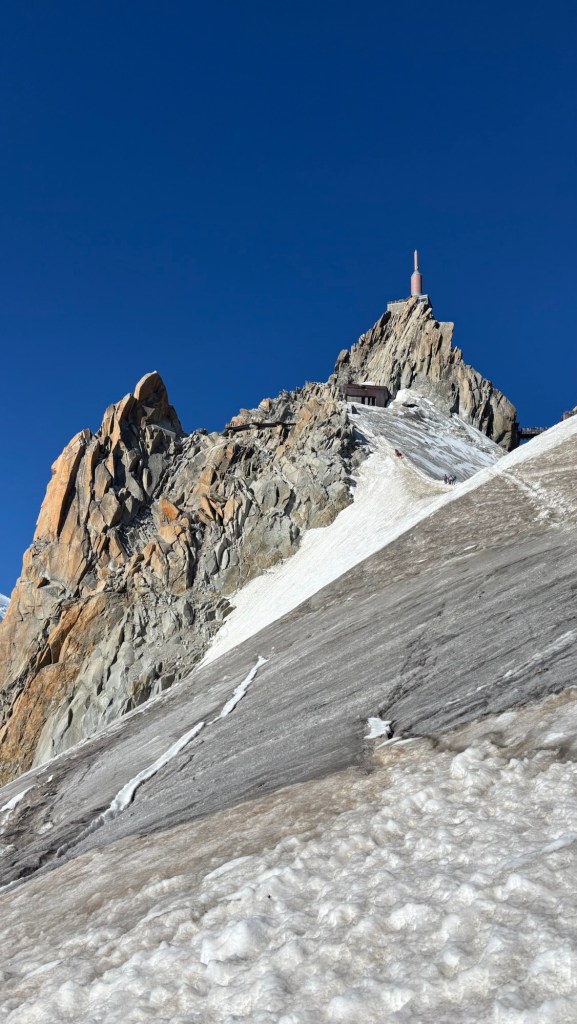
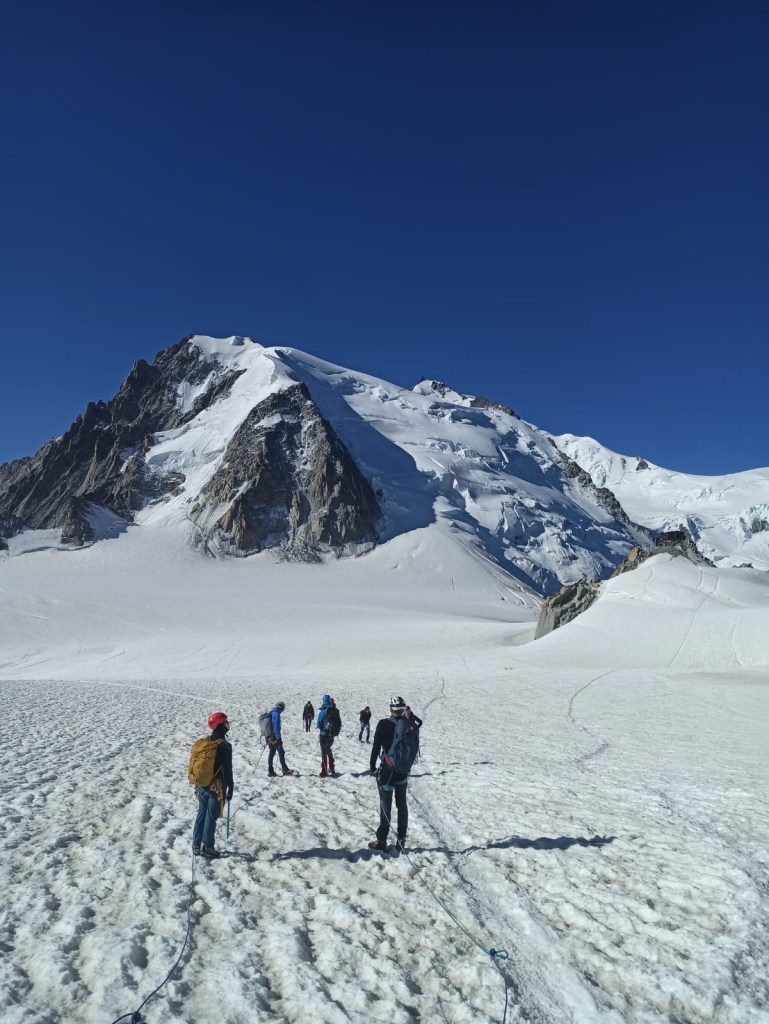
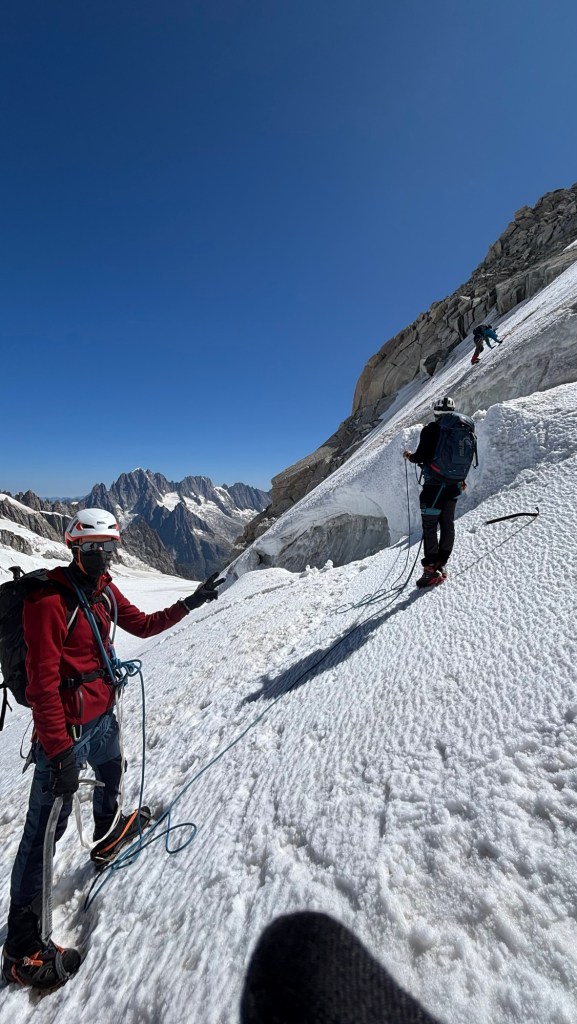
The next morning we were up for a 7am breakfast — late, for alpinists! — and a short walk up to the Plan de l’Aiguille cable car which brought us up to the Aiguille du Midi lift station. Weaving through underdressed, shivering tourists we stopped in the hallway outside the ice cave to rope up and put on our crampons. One of the UCPA groups in our refuge had forgotten their ropes and had been loaned one of ours, so instead of 3 ropes of two we were 2 ropes of three. I was in the middle of my rope with Eric and Guillaume on either end — I took no issue with this as I was nervous for the steep and exposed descent on the icy arete down to the Col du Midi, which was even worse than I expected. This will probably end up being one of the worst summers for conditions in the Alps, with sustained heatwaves beginning in early June with almost no respite. The normally-snowy ridge was slushy in places, with fixed ropes over a rocky section that had been bared, and one icy portion reminiscent of the Mer de Glace, with rocks embedded in firm ice and no grip for your crampons. I skated down on a tight rope from Eric behind and finally began breathing again when we returned to the slush, ignoring the 2000 meter drop straight back to Chamonix on my left (better to not think about it). The sun beating down on us and reflecting off of the dazzling white plateau of the glacier, we hopped over a crevasse, extended our ropes for glacier travel and began a long slog in the general direction of Mont Blanc de Tacul.
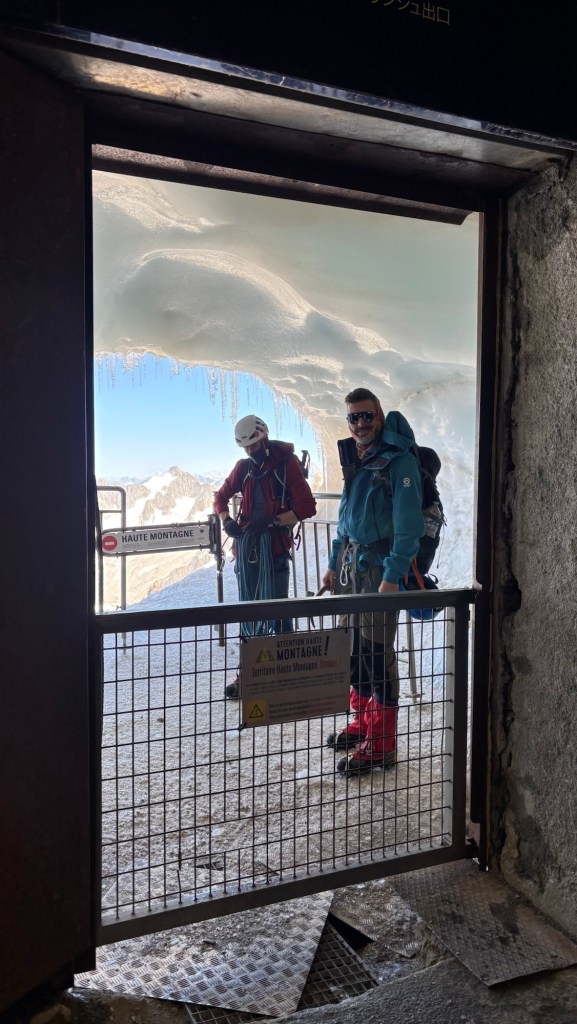
As we started trudging uphill to Pointe Lachenal I could feel the altitude beginning to affect me, as I tried to focus on just putting one foot in front of the other, placing my crampons correctly, and getting as much air as possible into my lungs. After what felt like an eternity Eric brought us over to scope out the bergschrund — a large crevasse where glacier peels away from the rock. Given the heatwaves, this bergschrund had expanded into a massive crevasse, almost a meter wide, with no good snow bridge to cross it. We turned around and moved further along the glacier, before Eric put out a call for everyone’s ice screws, which we dutifully passed forward. A few minutes later he began leading up the mountain’s steep north face, placing screws and clipping in as he went. I nervously shuffled forward as he yelled out to me, grabbed my axe in one hand and began following him up. Kick, kick, axe. Kick, kick, axe. I tried not to think too hard, but the crappy, rotten ice seemed to crumble under each step, and with only one axe to balance myself I felt my heart in my throat every time a foot placement wobbled. Finally I arrived to Eric, who was belaying me off a rock, and the group continued up a short rock scramble to the summit, which offered panoramic views over the surrounding peaks, including back to my “home” mountains, the Dents du Midi! Then it was time to descend — which I had been dreading since the ascent. With a reminder to keep the rope tight without pulling anyone off the mountain, Eric sent Guillaume down first. As the middle climber, my job was to reach each piece of protection, unclip the protection from below me and re-clip it to the rope above me. This took a bit of time, so when I paused at the first ice screw I could feel Guillaume advancing and beginning to pull me down. “Tire pas la corde, Guillaume!!” I shrieked, hands shaking as I re-clipped. He apologized and we made our way down safely back to the bergschrund. The whole thing couldn’t have taken more than 5 or 10 minutes but felt like an hour for me as I tried to keep a good rhythm and lower myself onto my crampons. Kick, kick, axe. Kick. kick, axe. Our ice climbing excursion done for the day, we re-crossed the glacier to climb the Arete a Laurence, a rocky ridge scramble that served to bring my cortisol levels back down to semi-normal. Guillaume, on the other hand, was clearly nervous moving along the exposed rock moves. “How you feel on the ice, Eva,” he exclaimed, “this is how I feel on the rocks!”. Touchée, Guillaume. We finished the Arete, hopped over the terrace fence, and treated ourselves to lunch at the charming Refuge des Cosmiques, which is under constant monitoring due to its somewhat unstable position on the ridge. After lunch we geared up and dragged ourselves back over the glacier and up once again the Midi Arete. It feels steep and scary coming down — I was not expecting to also feel so daunted going up! But there was nothing to do but to try and turn my brain off, put one foot in front of the other, and plant my crampons well with each ragged breath. After an eternity, we were back in the ice cave, coiling our ropes and jumping back over the warning fence, while an annoyed tourist grumbled that there were alpinists intruding in the photo she tried to take of the “Danger: Haut Montagne” sign. I suggested that we might be offering some authentic high-mountain ambiance, which led to snickers from the group.
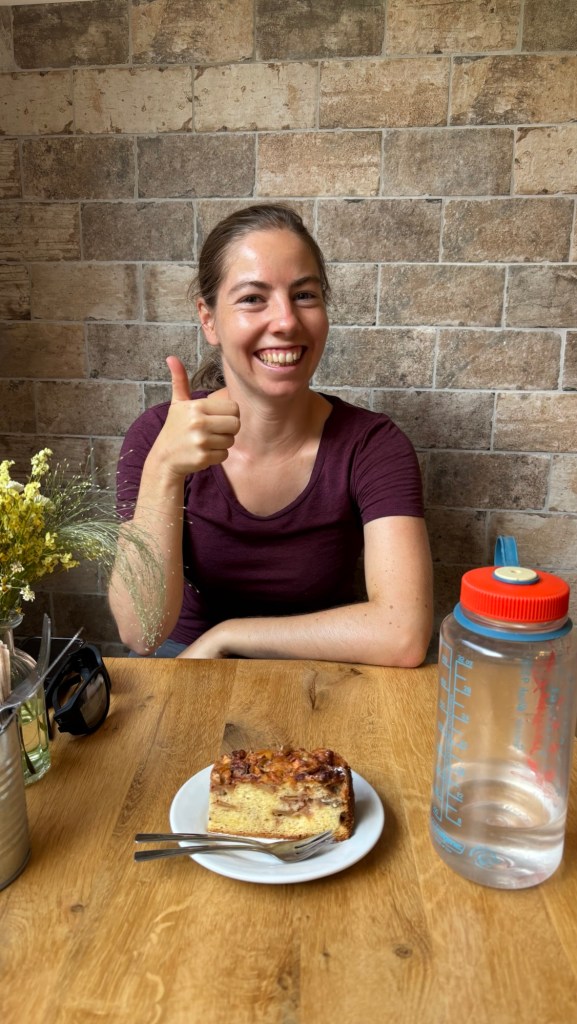
Safely back on the ground in Chamonix, we baked in the hot sun of this summer’s never ending heatwave and debriefed our journey with the other groups. Towards the end Theresa and I fell in with a British group spanning the first and second Alpinism levels, and were happy to hear that everyone had made it back in one piece. Exhausted, we downed grande panaches, played an excruciating game of pool with the Brits (Theresa and I were very bad, so it was shocking how long it took for the guys to beat us) and then finally crawled into bed. It was a long and jam-packed 5 days, but both Theresa and I came away feeling much more confident in our skills and ready to go tackle more ridge routes. In fact, we considered going out the following morning, but the promise of a lie-in and the threat of afternoon thunderstorms convinced us to spend the last morning hanging out in town, eating apple cake at Couloir cafe (as recommended by Melissa).
I was supposed to head directly to the Argentiere campsite on Saturday, but what had started as a sore throat on Thursday had morphed into a concerning cough and serious congestion. I figured that spending the weekend shivering in my tent during the storms was unlikely to lead to a speedy recovery. So, in the end I made the decision to head home with Theresa, sleep in my own bed for a night or two, and return to Chamonix for the rest of my holidays when the weather improved. I’ve never vacationed so hard that I had to take a break from my vacation….but hey, there’s a first time for everything!
2 days at home, many extra hours of sleep, and approximately 10,000mg of vitamin C (plus 3 hours in an air conditioned theater watching the Odyssey) worked their magic, and I did indeed return to Chamonix the following week. But that’s for another blog post.
To be continued…


Leave a Reply